
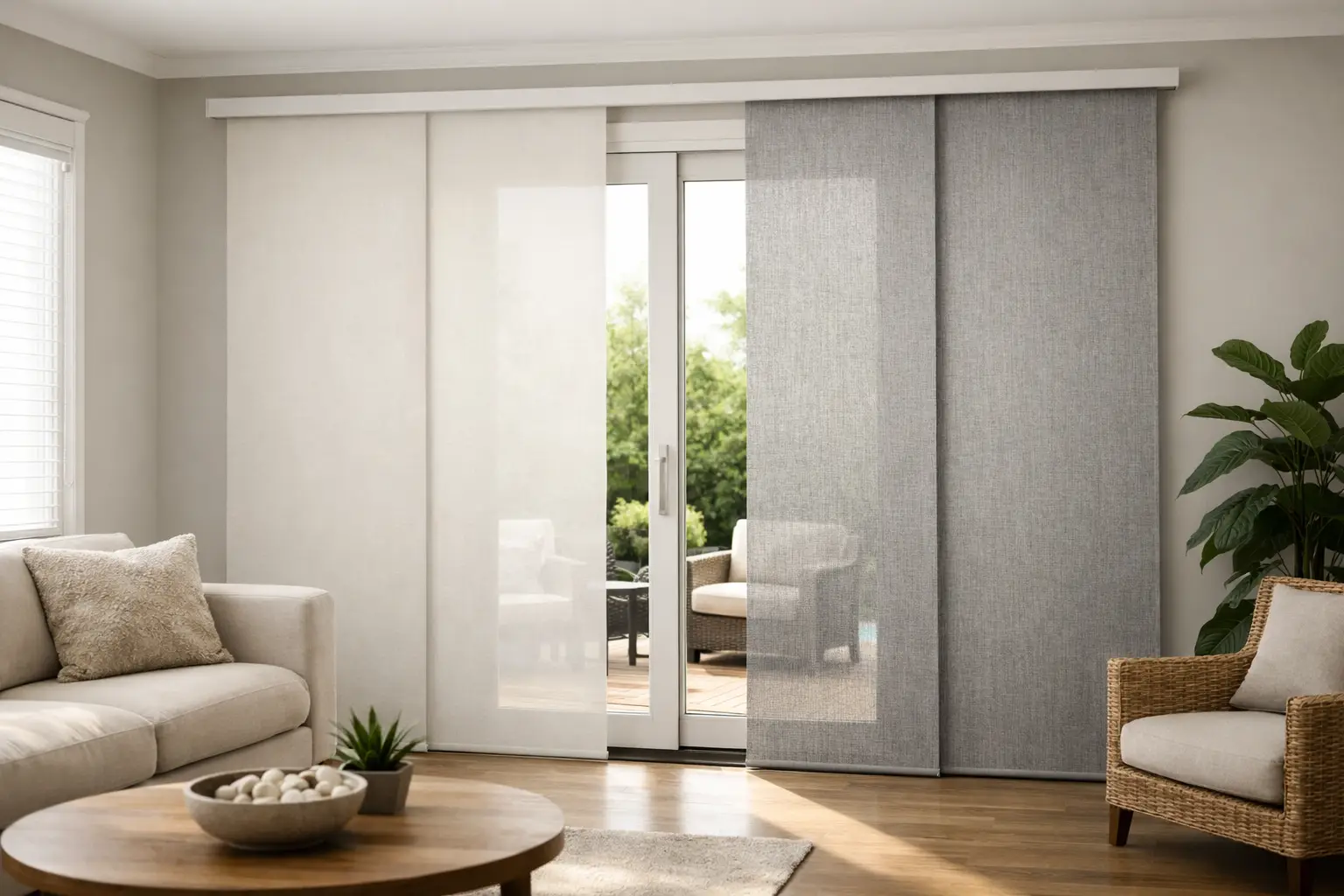
Panel Track Blinds for Patio Doors
A patio door can make a room feel bigger, brighter, and more connected to the outdoors – right up until the afternoon glare hits the sofa, privacy disappears after sunset, or a bulky window treatment starts fighting the door every day. That is where panel track blinds for patio doors stand out. They are built for wide openings, they move with a simple side-to-side glide, and they give large glass doors a cleaner, more architectural look than many traditional options.
For homeowners and designers weighing function against finish, panel track systems sit in a useful middle ground. They are practical enough for everyday traffic and polished enough for living rooms, great rooms, condos, and open-plan spaces where the patio door is always in view.
Why panel track blinds work so well on patio doors
Patio doors ask more of a window treatment than a standard window. The covering needs to span a wide opening, stack efficiently, allow quick access, and still look intentional when open or closed. Panel track blinds are designed around that exact challenge.
Instead of many narrow slats, the system uses large fabric or woven panels that slide along a track. The result is a flatter, more streamlined profile. On a wide sliding door, that matters. You get coverage without the visual busyness that can come with vertical blinds, especially in contemporary interiors.
They also stack more neatly than some people expect. When open, the panels slide to one side or split in the center, depending on the configuration. That gives you flexibility based on furniture layout, traffic flow, and which side of the patio door you use most often.
From a design standpoint, panel track blinds feel more integrated with the room. They read less like an afterthought and more like part of the overall finish scheme. If your space includes broad sightlines, neutral materials, and large-format windows, that cleaner appearance is often the deciding factor.
Panel track blinds for patio doors vs. other common options
The right choice depends on the room, the amount of daily use, and the look you want. Panel track blinds are not the answer for every opening, but they solve a specific set of problems very well.
Vertical blinds are often the most familiar comparison. They can be cost-effective and functional, especially for utility spaces or rental properties. But visually, they tend to create more movement and pattern across the glass. Panel track systems feel calmer and more refined because the panels are wider and the lines are simpler.
Drapery is another strong option for patio doors, especially in formal or layered interiors. It brings softness and excellent design flexibility. The trade-off is stack space, maintenance, and sometimes more fabric bulk than a modern room needs. If you want a tailored look with less fullness, panel track blinds may be the better fit.
Roller shades can work on patio doors in certain layouts, particularly if the opening is divided into separate sections. But on very wide expanses, multiple shades can introduce more seams and hardware than some clients want. Panel track systems are often better when the goal is broad coverage with fewer visual interruptions.
What to look for when choosing panel track blinds
Not all panel track blinds for patio doors perform the same way. The fabric, track system, panel width, and operating style all influence how the finished installation will look and feel.
Fabric selection usually drives both performance and appearance. Light-filtering materials soften daylight and reduce glare without making the room feel closed off. That is often ideal for family rooms or main-floor living areas where you want daytime comfort but still appreciate natural light. Room-darkening materials offer more privacy and stronger light control, which can be useful in media rooms, bedrooms with balcony doors, or homes with close rear neighbors.
Texture matters too. Smooth screen-like fabrics support a clean, minimal look. Woven materials add warmth and dimension, which can help large glass areas feel less stark. The best choice depends on the rest of the room. A crisp modern interior may benefit from a simple, matte fabric, while an organic or transitional space often looks better with a textile feel.
Track quality should not be overlooked. A patio door treatment gets used constantly. If the glide is rough or the stacking is awkward, you will notice it quickly. A well-made track system supports smooth operation, cleaner alignment, and better long-term performance.
Panel width also affects the final look. Wider panels generally create a more modern appearance with fewer vertical lines. Narrower panels can give you more pattern repetition or tighter stack options. This is one of those details that is hard to judge from a swatch alone and easier to evaluate with expert guidance.
Design considerations that change the outcome
A panel track system may seem straightforward, but several installation and design decisions can make the difference between a treatment that feels custom and one that feels generic.
Mounting height is a big one. In many rooms, placing the track higher can visually lengthen the wall and make the patio door feel more substantial. Width matters just as much. Extending beyond the glass can help the panels stack off the opening more effectively, preserving the view and admitting more natural light when the blinds are open.
Panel stack direction should follow how the door is used. If one side is the active panel, the blinds should be planned so access feels natural. A beautiful product that blocks the everyday traffic path is not a smart specification.
Color deserves more attention than people often give it. Matching the wall creates a quieter, built-in effect. Choosing a tone that ties into flooring, upholstery, or trim can make the treatment feel more intentional. On large patio doors, the window covering takes up enough visual space to influence the entire room palette.
Are motorized panel track blinds worth it?
For many homes, yes – but it depends on the opening and the expectations for convenience. Motorization is especially appealing on large, frequently used patio doors or in homes where automation is already part of the lighting and shade plan.
A motorized panel track system can improve ease of use and help protect the treatment from daily tugging or uneven handling. It also supports scheduled privacy and solar control, which is useful in rooms with strong afternoon exposure. If the patio doors face west or open into a space with heat buildup, automation can become more than a luxury feature.
That said, manual systems are still a good fit in many projects. They are straightforward, dependable, and often fully sufficient for smaller spaces or lower-traffic rooms. The right decision usually comes down to budget, frequency of use, and how integrated the home is with smart controls.
Measuring and fit matter more than most people expect
Wide openings leave less room for error. Even a small measuring mistake can affect panel overlap, stack location, floor clearance, and overall symmetry. Patio doors also bring in variables such as handles, adjacent trim, nearby walls, and furniture placement.
This is one reason custom specification matters. Off-the-shelf solutions can be tempting, but they often fall short on proportion and function, especially when the opening is oversized or the room has architectural constraints. A made-to-measure system allows the panels, track, and operation style to be tailored to the exact opening rather than forced into it.
For homeowners who want help comparing materials, light control levels, and brand options, working with a specialist can save time and prevent expensive guesswork. Window Fashions Depot supports that process through consultation, product selection, and quote-driven planning at https://Windowfashionsdepot.com.
When panel track blinds are the right choice
Panel track blinds are a strong option when you want a patio door treatment that feels current, covers a wide span cleanly, and handles daily use without looking heavy. They are especially effective in condos, open-concept living spaces, modern renovations, and homes where large glass doors are a central visual feature.
They may be less ideal if you want a very soft, decorative look or if the room calls for heavy blackout layering with a more traditional style. In those cases, drapery or a layered combination may be the better route. But if the goal is simplicity, custom scale, and controlled light with a more architectural finish, panel track systems deserve serious consideration.
The best patio door treatment is rarely the one with the most features on paper. It is the one that fits the opening correctly, suits the room, and works well every single day. For many spaces, panel track blinds do exactly that.