
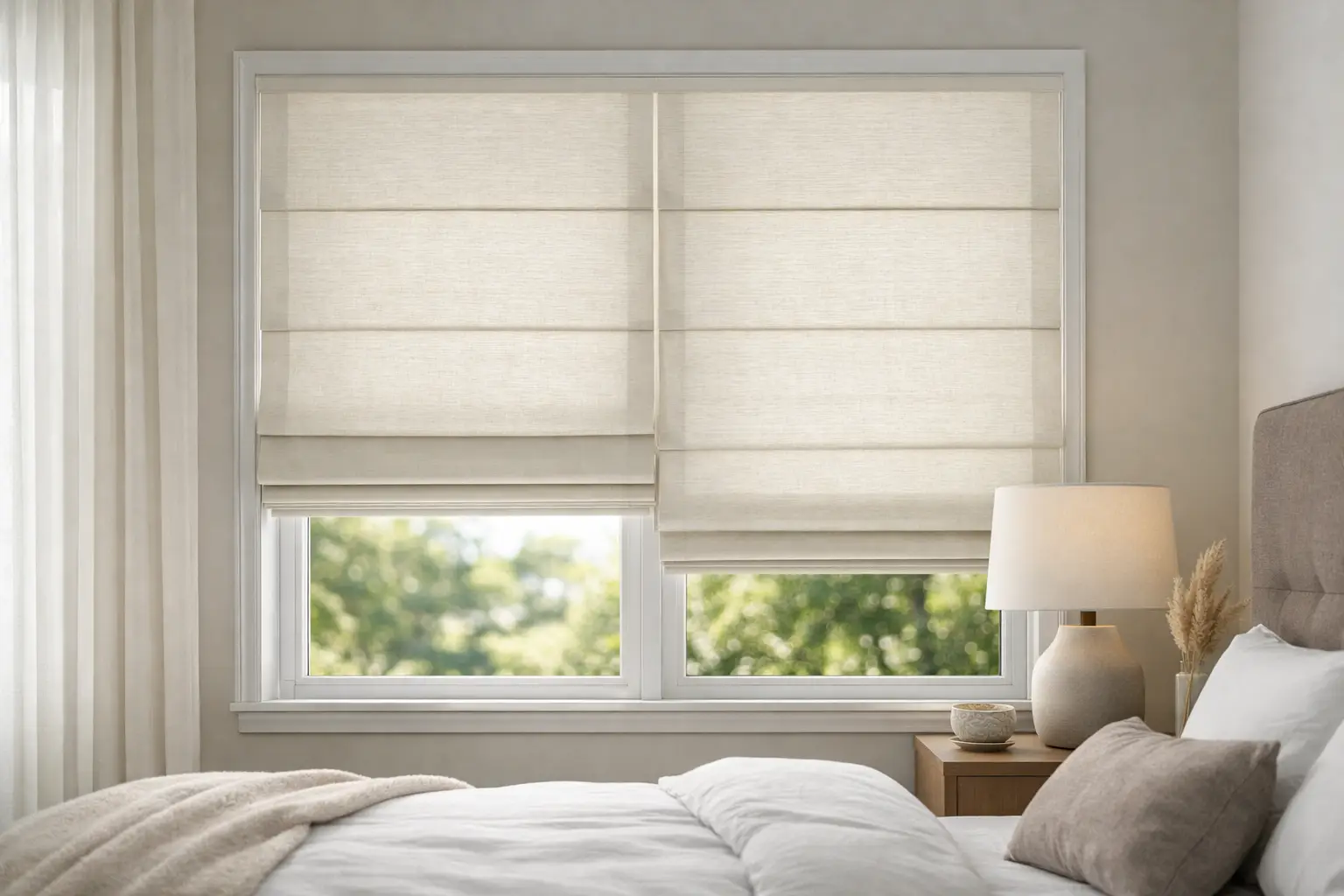
Roman Shades for Bedroom Privacy
A bedroom can look beautifully finished and still feel exposed the moment the lights come on at night. That is usually the point when homeowners start asking about roman shades for bedroom privacy – not just whether they look good, but whether they actually give the room the coverage, light control, and comfort a bedroom needs.
Roman shades are one of the few window treatments that can make a bedroom feel softer and more tailored without giving up function. They bring fabric, texture, and clean lines to the window, which is why they are a strong choice for primary bedrooms, guest rooms, and condo bedrooms where windows are often large and sightlines are close. The key is choosing the right fabric, lining, and operating system for how the room is used.
Why Roman shades work well in bedrooms
Bedrooms ask more of a window treatment than most rooms. You want privacy in the evening, softer daylight in the morning, and a finished look that supports the rest of the design. Roman shades handle that balance well because they sit close to the window, stack neatly when raised, and can be specified in a wide range of fabrics from airy linens to room-darkening textiles.
They also solve a common design problem. Harder treatments such as aluminum blinds or basic vinyl shades can control light, but they rarely add warmth. Roman shades introduce fabric in a more architectural way than drapery alone, especially when space is limited or when a cleaner profile is preferred.
That said, privacy performance depends on specification. A loosely woven decorative fabric will not perform the same way as a lined shade made for bedrooms. This is where custom selection matters.
Choosing roman shades for bedroom privacy
If privacy is the priority, fabric opacity is the first decision to get right. Sheer and semi-sheer fabrics can look elegant during the day, but they are not ideal for bedrooms on their own. At night, interior lighting can turn a beautiful shade into a silhouette screen. For true privacy, most bedrooms benefit from either a privacy lining or a blackout lining, depending on how dark you want the space.
Privacy lining is often the right middle ground for homeowners who want filtered daylight but do not need total darkness. It helps obscure visibility from outside while keeping the shade softer and less heavy than a blackout construction. Blackout lining is better for bedrooms facing streetlights, neighboring homes, or early morning sun, and it is often preferred in nurseries and media-focused bedroom spaces.
Window placement matters too. A second-floor bedroom with distant neighboring homes may only need privacy lining. A ground-floor bedroom facing a sidewalk, driveway, or condo tower usually needs more complete coverage. The right answer is not always the darkest option. It is the option that fits the room’s exposure, your sleep habits, and the look you want.
Fabric and fold style make a difference
Roman shades are not one look. The style of fold changes how tailored or relaxed the room feels, and that affects bedroom design more than many people expect.
Flat Roman shades have a clean, contemporary face and are especially effective when you want to highlight a beautiful fabric pattern or keep the window treatment visually quiet. Hobbled or soft-fold Roman shades create more dimension and a traditional softness, which can work well in classic interiors or layered bedroom schemes. Relaxed Romans bring a casual drape that suits transitional and softer modern spaces, though they are usually chosen more for aesthetics than for the crispest tailored finish.
Fabric weight matters just as much. Heavier fabrics tend to feel more substantial and private, while lighter fabrics create an airy look but may need lining to perform properly. Texture is another consideration. Bedrooms often benefit from woven solids, tone-on-tone patterns, or subtle natural textures that bring depth without making the window the loudest feature in the room.
Light control is not the same as privacy
This is where many shoppers get tripped up. A shade can reduce light and still fall short on privacy, or it can provide privacy while still letting in a fair amount of glow. These are related functions, but they are not identical.
If the room gets strong morning sun and you are a light sleeper, room-darkening or blackout Roman shades may be the better fit. If your main concern is blocking views from outside in the evening while still keeping the room bright during the day, privacy-lined Roman shades may be more appropriate. Some homeowners also pair Roman shades with drapery panels to soften the room visually and improve side light control.
That layered approach is especially effective in primary bedrooms where design and performance both matter. The Roman shade handles the core privacy and fit, while side panels add visual height, softness, and extra light management. It is a strong solution for larger windows and bedroom suites where a more complete design treatment is desired.
Inside mount or outside mount?
Mounting style affects both appearance and coverage. Inside-mounted Roman shades sit within the window frame and create a tailored, built-in look. They are popular in modern and transitional bedrooms, especially where trim details are worth showing off. The trade-off is that inside mounts can allow a small amount of light gap at the sides, which may matter if privacy or darkness is a top concern.
Outside-mounted shades typically provide more complete coverage because they extend beyond the window opening. That makes them a smart choice for bedrooms where privacy is critical, where the window frame is shallow, or where you want the window to appear larger. They can also help minimize side light leakage, which is useful in bedrooms with bright exterior lighting.
There is no universal best choice. Inside mount usually wins on architectural neatness. Outside mount often wins on performance. A consultative approach helps balance both.
Motorization and everyday convenience
Bedrooms are one of the best rooms in the home for motorized shades. It is not only about technology for its own sake. It is about convenience, especially for larger windows, hard-to-reach placements, or homeowners who want the room to transition easily from morning light to nighttime privacy.
Motorized Roman shades can be scheduled to open gradually in the morning or close automatically at sunset. For primary bedrooms, that can make daily use much more consistent. If a shade is difficult to reach or cumbersome to adjust, people often leave it in one position and lose some of the benefit they paid for.
For design professionals and homeowners planning a broader smart-home setup, Roman shades can also be integrated with automation systems from premium brands such as Lutron or Somfy, depending on the project scope. Battery-powered and hardwired options each have advantages, so the right choice depends on access to power, new construction versus renovation, and how many windows are involved.
Where custom Roman shades outperform off-the-shelf options
Bedrooms are rarely forgiving spaces for poor fit. Even a small measuring error can create noticeable light gaps, a crooked hemline, or a shade that does not stack properly. Off-the-shelf products may work for basic temporary needs, but they often fall short when privacy, finish quality, and fabric coordination matter.
Custom Roman shades offer more control over width, height, lining, fold style, hardware, and operation. That becomes especially valuable in bedrooms with oversized windows, narrow openings, specialty shapes, or design schemes that call for a specific fabric story. It also matters if you are coordinating window treatments across a full home and want the bedroom to connect with adjoining spaces without feeling repetitive.
This is often where a showroom-driven selection process helps. Seeing fabric samples in person, comparing fold styles, and discussing exposure conditions can prevent expensive missteps. For homeowners in Toronto and across the GTA planning installed projects, and for clients ordering shipped custom products across Canada and the USA, guidance on specification can be just as important as the shade itself. Window Fashions Depot approaches Roman shades as a design-and-performance decision, not a one-size-fits-all purchase.
What to consider before you order
Before selecting Roman shades for a bedroom, think through how the room is actually used. Do you sleep during the day? Are there streetlights outside? Is the window visible from neighboring homes? Do you want the shade to disappear visually or become part of the room’s decorative layer? These answers shape the right fabric and lining more than trends do.
It also helps to consider who uses the room. A guest room may prioritize a polished look and moderate privacy. A child’s bedroom may need cordless safety and stronger room darkening. A primary bedroom often calls for the most balanced solution – privacy, aesthetics, smooth operation, and enough light control to support better sleep.
The best Roman shade is rarely just the prettiest fabric on the card. It is the one that fits the window correctly, performs at night, complements the room, and feels easy to use every day.
A bedroom should feel private without feeling shut in. Done well, Roman shades give you that balance – soft, custom, and practical in all the ways that matter once the lights go on.