
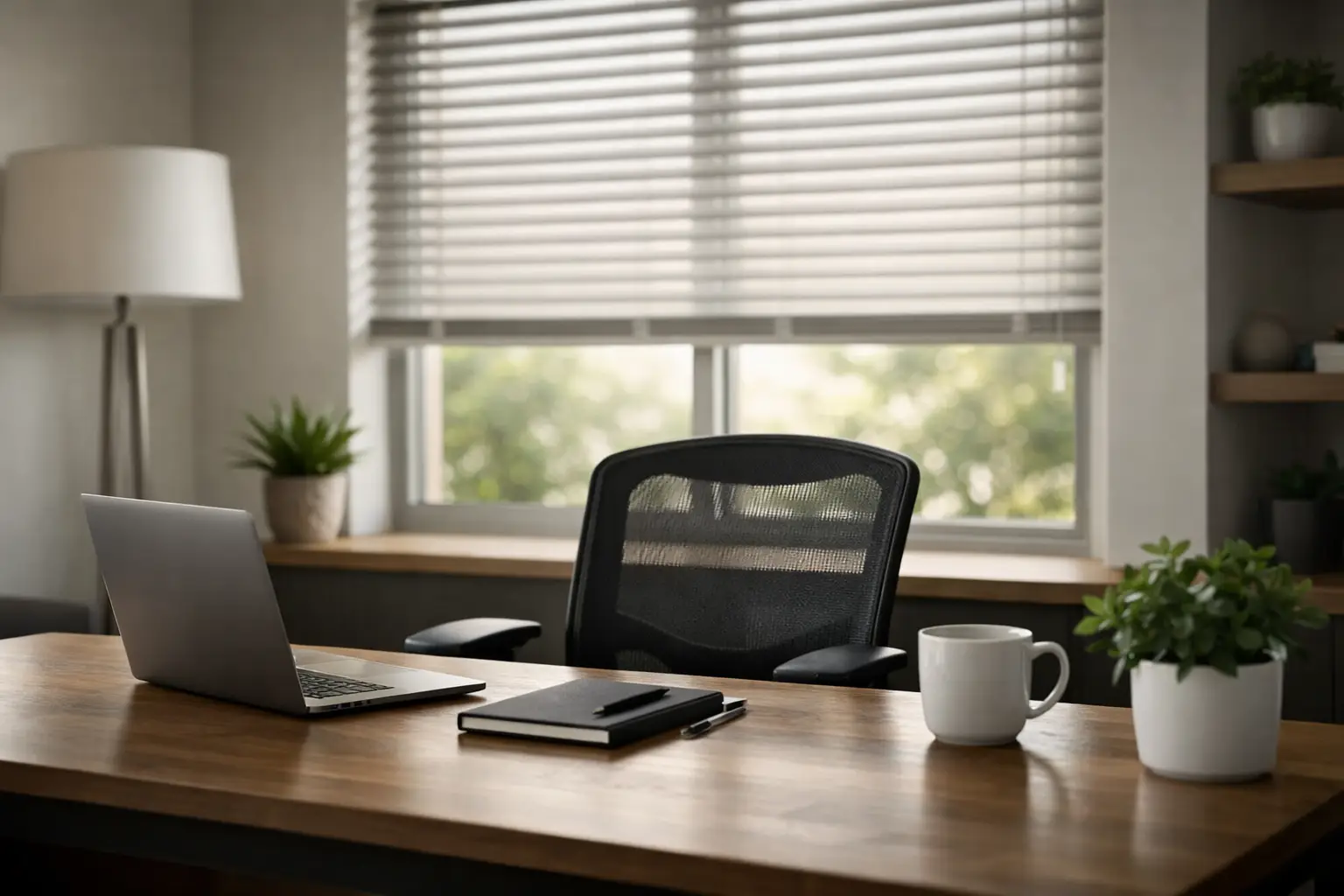
Best Blinds for Home Offices for Better Focus
A home office window can be the difference between a productive workspace and a daily battle with screen glare. Morning sun may look inviting until it washes out a monitor. Afternoon heat can make a compact office uncomfortable, while an exposed street-facing window can make video calls feel far less private. The best blinds for home offices address all of these concerns without making the room feel closed off.
The right choice depends on window direction, monitor placement, privacy needs, and the character of the room. For many homeowners, the answer is not simply a blind versus a shade. It is a custom window treatment selected for the exact light, insulation, and design demands of the office.
What Home Office Blinds Need to Do
A successful home office treatment should manage daylight rather than eliminate it. Natural light can make a workspace more pleasant and reduce reliance on overhead fixtures, but direct rays on a computer screen create reflections, visual fatigue, and distracting contrast. A treatment with adjustable vanes, a dual-fabric system, or a carefully selected openness factor gives you more control throughout the day.
Privacy is equally important, particularly in offices facing a neighbor, sidewalk, or busy street. Consider what is visible after dark when interior lights are on. Some sheer or solar materials provide excellent daytime privacy yet offer little protection at night, so they may need a secondary layer or a more opaque fabric.
Energy performance also deserves attention. South- and west-facing offices often gain substantial heat, while windows near a desk can feel chilly in winter. Cellular constructions, insulating fabrics, and close-fitting shades can improve comfort at the desk and help moderate temperature swings. Finally, the treatment should suit the room. A polished study, a modern condo workspace, and a multipurpose guest room each call for a different visual approach.
Best Blinds for Home Offices by Need
Roller shades for clean glare control
Roller shades are often the most versatile choice for a modern home office. Their streamlined profile works well in smaller rooms, and the fabric selection is extensive, from light-filtering textiles to room-darkening and blackout options. Solar screen roller shades are especially useful where daylight and exterior views matter. They cut glare and UV exposure while maintaining a degree of outward visibility.
The key specification is openness factor. A lower openness factor blocks more light and provides greater daytime privacy, while a higher factor preserves a clearer view but allows more light through. For a desk positioned near a bright window, a lower openness solar fabric is usually the more comfortable starting point. For a room with indirect light, a more open fabric may be sufficient.
Roller shades are also ideal for dual-shade systems. Pairing a solar shade with a blackout roller shade lets you work in softly filtered light during the day, then create full privacy for evening calls or use the room as a guest bedroom when needed.
Cellular shades for insulation and soft light
Honeycomb, or cellular, shades are a practical option for offices where temperature control is a priority. Their cellular pockets trap air, helping reduce heat gain in summer and heat loss in cooler months. They also soften incoming light beautifully, making them particularly suited to offices with broad windows or uncomfortable sun exposure.
Choose light-filtering cellular shades when you want a bright, calm workspace without harsh sunlight. Select blackout fabrics when the office doubles as a media room, nursery, or bedroom. Top-down/bottom-up operation can be especially valuable in a ground-floor office: lower the top section to bring in daylight while keeping the bottom of the window covered for privacy.
The trade-off is view preservation. Unlike solar roller shades, cellular shades do not provide a clear view through the fabric when lowered. For homeowners who value the landscape outside their office, that distinction matters.
Wood and faux wood blinds for adjustable light
Horizontal wood blinds and faux wood blinds offer precise control over the direction of sunlight. Tilt the slats upward to diffuse brightness across the ceiling, or angle them down to block direct rays at the desk. This adjustability makes them a strong choice when the office receives shifting sun throughout the day.
Real wood brings warmth and architectural character to an office, especially beside built-ins, hardwood floors, or traditional furnishings. Faux wood offers a similar tailored appearance with strong resistance to moisture and warping, making it a sensible selection for humid rooms or windows near a kitchen or bath.
Keep in mind that slats can collect dust and require more regular cleaning than a smooth roller shade. They also have more visual presence. That can be an advantage in a formal study but may feel busy in a minimal, contemporary workspace.
Vertical blinds and panel track systems for wide windows
Large windows and sliding glass doors require a treatment that moves horizontally. Vertical blinds remain a functional, budget-conscious option, offering adjustable light control and easy access to the door. For a more contemporary finish, panel track systems use wide fabric panels that glide across the opening in a clean, architectural line.
Both options suit home offices that open to a balcony, patio, or backyard. Fabric vanes and panels can soften acoustics somewhat, which is useful in open-concept homes. When specifying either treatment, consider the stack position so open panels do not interfere with your preferred path to the door or obstruct a portion of the glass.
Roman shades for a more decorative office
Roman shades are a natural fit when the office is visible from a main living area or shares space with a guest room. They introduce texture, pattern, and a more furnished look than most blinds. Lined Roman shades can provide effective light control and privacy, while a relaxed or tailored fold can reinforce the room’s design direction.
Their limitation is fine adjustment. A Roman shade is generally raised or lowered rather than tilted in small increments, so it is less adaptable than a venetian blind during rapidly changing sun conditions. They work best in offices with manageable light exposure or as part of a layered window treatment.
Match Opacity to the Window Direction
Window orientation should shape your fabric and control choices. East-facing offices receive strong morning light, which can be disruptive for early work hours. A solar roller shade, cellular shade, or adjustable blind helps tame that low-angle sun without darkening the entire room.
South-facing windows tend to receive consistent daylight. Light-filtering shades often perform well here, though offices with multiple monitors may benefit from a lower openness solar fabric. West-facing windows demand the most heat and glare control in the afternoon. Consider insulating cellular shades, darker solar fabrics, or a layered system with blackout capability.
North-facing offices usually receive softer, cooler light. In these rooms, prioritize privacy and design over aggressive solar control. A translucent roller shade, woven wood shade with a privacy liner, or wood blind may provide all the function required.
Motorized Blinds Make Light Control Easier to Use
The best window treatment only works when it is used consistently. Motorization makes that more likely, especially for wide windows, high windows, or offices where the desk is positioned away from the controls. With a remote, wall control, app, or compatible smart-home system, shades can lower before direct sun hits the monitor and rise when the glare has passed.
Motorized roller shades, cellular shades, Roman shades, and horizontal blinds can be specified with premium systems from manufacturers such as Hunter Douglas, Lutron, Somfy, and Graber. Battery-powered options can simplify retrofit projects, while hardwired solutions are often worth considering during a renovation or new build. Scheduling is particularly useful for a home office: set shades to follow your workday, reduce afternoon heat, and protect furnishings from UV exposure.
Details That Separate a Good Fit From a Great One
Inside mount treatments create a crisp, integrated look when the window has adequate depth and square, unobstructed frames. Outside mount treatments can make a window appear larger and are often better for maximizing light coverage or reducing light gaps. For blackout performance, outside mounting with proper overlap is usually the stronger choice.
Measure around obstacles before selecting a product. Window handles, cranks, trim, shallow recesses, and nearby shelving can all affect the mounting method and operation. Also consider the placement of your monitor. If possible, position the screen perpendicular to the window rather than directly in front of or behind it. This reduces glare before the window treatment needs to do all the work.
A custom consultation is valuable when the office has multiple exposures, oversized glazing, unusual window shapes, or a need to coordinate with surrounding rooms. Window Fashions Depot can help compare materials, opacity levels, operating systems, and finishes in person, then specify a treatment that looks intentional rather than merely functional.
The most effective home office window treatment is one you barely notice during the workday. It keeps glare off the screen, preserves privacy when the lights come on, and gives the room a finished appearance that supports focused work.