
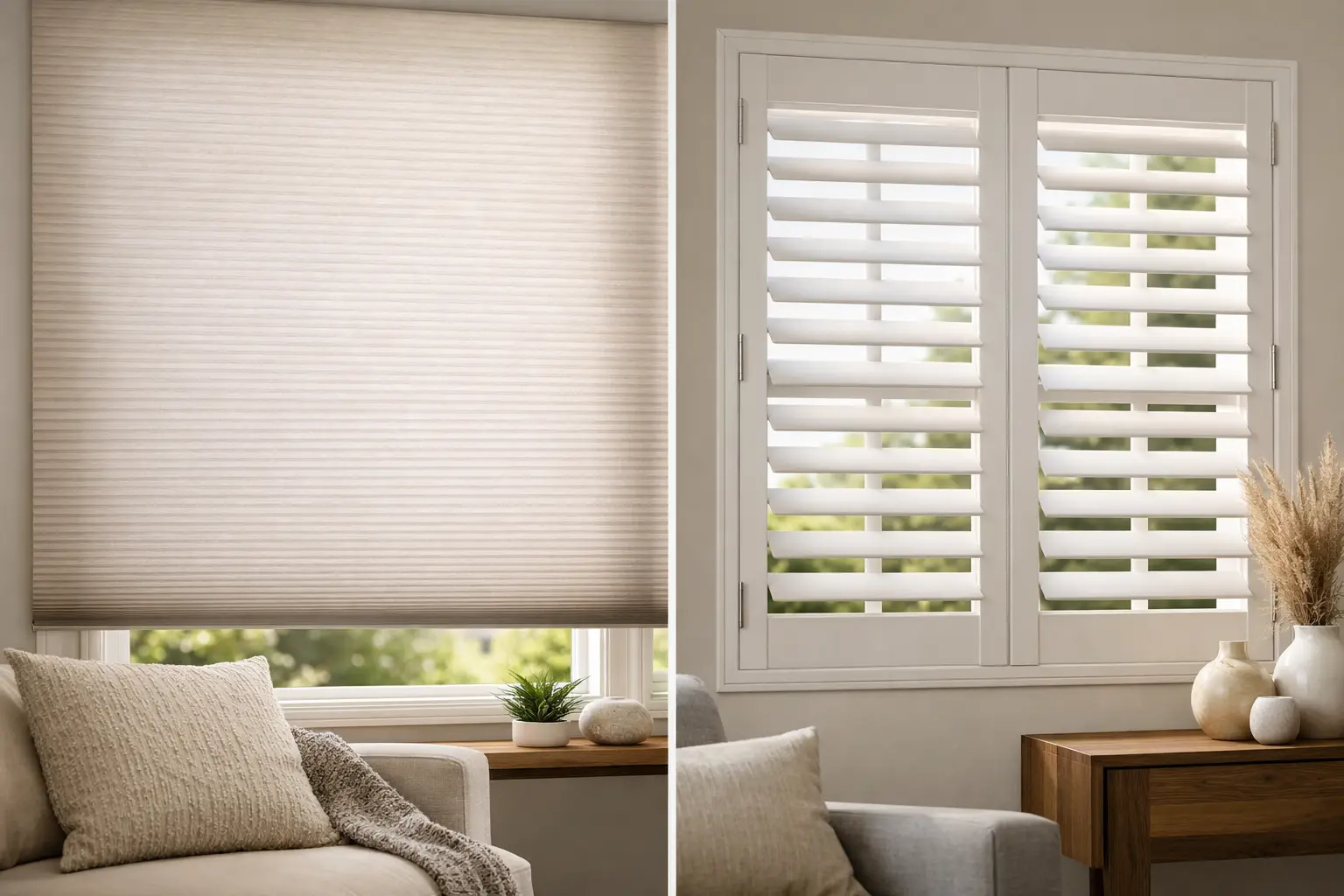
Honeycomb Shades vs Shutters: Which Fits?
A west-facing living room can make the choice clear fast: do you need to soften heat and glare across a large expanse of glass, or do you want an architectural finish that holds its own against millwork and furniture? When comparing honeycomb shades vs shutters, both offer meaningful privacy, light control, and custom-fit appeal. They simply solve the problem in very different ways.
Honeycomb shades are fabric shades built with air-trapping cellular pockets. Shutters are rigid, louvered panels, typically specified in wood, composite, or vinyl. One disappears into the window opening when raised; the other becomes a permanent visual feature. The better choice depends on the room, the window, and what you want the treatment to do every day.
Honeycomb Shades vs Shutters at a Glance
Honeycomb shades are usually the stronger performer when insulation, a clean low-profile look, and flexible coverage are the priorities. Their cellular construction creates an insulating layer at the glass, which can help moderate heat gain in sunny rooms and reduce the chill felt near windows in colder seasons. They are also available in a broad range of opacities, from light-filtering to room-darkening, with cordless and motorized operation available for convenience and child safety.
Shutters are often the better choice when the room needs structure, adjustable directional light, and a tailored architectural presence. By tilting the louvers, you can bring in daylight while limiting direct views into the home. They are durable, easy to wipe clean, and especially compelling where a finished, built-in appearance matters.
Neither is automatically more premium. A well-specified cellular shade and a custom shutter installation are both high-quality solutions. The distinction is whether you want softness and thermal performance or a defined, furniture-like finish.
Where Honeycomb Shades Perform Best
Energy efficiency and comfort
Honeycomb shades are designed around insulation. The cells hold air, helping slow the transfer of heat through the window area. This is valuable for bedrooms with cold winter windows, large family-room windows that receive afternoon sun, and condos where glass walls can create noticeable temperature swings.
Cell size, fabric opacity, side gaps, and mounting method all influence real-world performance. A single-cell shade may be appropriate for a moderately exposed window, while a double-cell construction can offer added insulation for more demanding exposures. The right choice should also account for the window frame, glass type, and any existing heating or cooling concerns.
A minimal, adaptable look
When raised, honeycomb shades stack into a relatively compact profile. That makes them particularly effective on windows with desirable trim, views, or limited wall space. They can feel quiet and modern rather than decorative, which suits contemporary interiors, bedrooms, home offices, and spaces where drapery will provide the primary design statement.
Fabric choices can be subtle or textural, and neutral shades work easily with changing furniture and paint colors. For a more tailored result, a custom specification lets you coordinate the shade color with wall tones, flooring, or surrounding finishes rather than settling for a close-enough option.
Flexible privacy and light control
Standard honeycomb shades raise from the bottom. Top-down/bottom-up operation adds another level of control by allowing the shade to lower from the top while keeping the lower portion covered. This is useful in street-facing rooms and bathrooms where you want daylight without exposing the interior.
For bedrooms and media rooms, room-darkening cellular fabrics are a practical option. They reduce incoming light substantially, although side light can still occur around the edges of the shade. If near-blackout conditions are required, consider precise inside mounting, light-blocking side channels where appropriate, or pairing the shade with drapery panels.
Where Shutters Make the Stronger Case
Architectural style that stays visible
Shutters frame a window even when the louvers are open. They add dimension and order to a room, making them a natural fit for traditional, transitional, coastal, and modern-classic interiors. In a home with substantial baseboards, paneled walls, custom cabinetry, or detailed trim, shutters can create continuity that a fabric shade cannot replicate.
Panel configuration matters. Tier-on-tier shutters allow the top and bottom sections to operate independently, offering excellent flexibility for privacy and light. Café-style shutters cover the lower portion of the window, preserving upper-window daylight and emphasizing a relaxed, design-forward look. Larger louvers often read more contemporary and preserve a clearer outward view when open; smaller louvers can feel more traditional.
Daylight with control over the view
A shutter’s greatest advantage is directional light control. You can angle louvers upward to reflect light toward the ceiling, limit glare, and reduce direct sightlines from outside. This makes shutters particularly useful in living rooms, dining rooms, front-facing spaces, and offices where the treatment will stay in place throughout the day.
That said, shutters do not offer the same full-window softness as a room-darkening shade. Closed louvers can dim a room effectively, but small lines of light remain between them. A shutter is a light-management system, not a blackout solution.
Durability and maintenance
Rigid shutter materials are easy to maintain. A quick dusting or wipe-down is often enough, making them practical for kitchens, busy family spaces, and homes with pets. Material selection is critical in humid settings. Composite or vinyl shutters are generally better suited to bathrooms, laundry rooms, and high-moisture areas than natural wood.
Wood shutters bring warmth and richness, but they should be specified thoughtfully around moisture and intense sun. Composite options can provide a similarly substantial appearance with strong stability and durability. The best material is not simply the most expensive one – it is the one that suits the conditions around the window.
The Trade-Offs That Usually Decide It
Cost is often part of the conversation, but it should not be the only deciding factor. Custom shutters typically require a higher initial investment because they are rigid, made to the opening, and professionally installed as a permanent feature. Honeycomb shades can also be premium, especially with double-cell fabrics, specialty operating systems, and motorization, yet they are often the more budget-flexible route for furnishing many windows at once.
Window shape and function matter just as much. Honeycomb shades can work well on narrow, tall, unusually sized, and some specialty-shaped windows. Shutters can also be custom built for challenging openings, but their panel layout, tilt mechanism, and clearance need careful planning. Casement windows, deep sills, handles, and inward-opening windows all deserve a detailed site review before selection.
Think about daily use, too. If you routinely raise a treatment completely to enjoy a view, a honeycomb shade is usually more convenient. If you prefer leaving the treatment in place and adjusting light throughout the day, shutters may feel more intuitive. Motorized honeycomb shades are especially appealing on tall windows, hard-to-reach openings, or smart-home projects. Shutters are generally manual, although specialty automation may be available for select applications.
Choosing by Room, Not Just by Product
Bedrooms often favor honeycomb shades because insulation, privacy, and room-darkening fabrics are high priorities. A layered design can combine cellular shades with drapery for added darkness, softness, and visual scale.
Living and dining rooms are more evenly split. Choose shutters when the windows are a defining architectural element and you want crisp adjustable light. Choose honeycomb shades when large glass areas create comfort issues or when a clean, understated treatment will support the rest of the interior.
Bathrooms and kitchens call for material awareness. Composite shutters are a dependable choice near moisture, while select honeycomb fabrics can work well where a softer, more discreet profile is preferred. In a home office, top-down/bottom-up cellular shades can be excellent for balancing daylight, privacy, and screen glare.
For whole-home projects, mixing treatments is often the most thoughtful solution. Using shutters in formal front rooms and cellular shades in bedrooms or secondary spaces can create a cohesive result without forcing one product to perform every job.
Get the Details Right Before Ordering
The difference between a good-looking treatment and a well-functioning one often comes down to specification. Measure the actual opening, review obstructions such as handles and cranks, consider inside versus outside mounting, and test how the window is used. Fabric opacity, louver size, shutter material, control type, and installation depth should be decided together rather than one at a time.
A showroom consultation can make this process easier because you can compare cellular fabrics against shutter finishes in person, operate the systems, and see how colors read under real light. At Window Fashions Depot, a custom consultation can also help coordinate treatments across different room conditions without losing the overall design direction.
The most satisfying choice is the one that makes the room easier to live in every morning and looks intentional every time you walk through the door.
0 comments