
Do Solar Shades Provide Privacy? What to Expect
A beautiful view can become a privacy concern the moment neighboring windows, a busy street, or interior lights enter the picture. So, do solar shades provide privacy? Yes, they can provide very effective daytime privacy, but their performance changes significantly at night. Choosing the right fabric openness, color, and secondary treatment is what turns a solar shade from a stylish light filter into a well-planned privacy solution.
Solar shades are a popular choice for living rooms, kitchens, home offices, condos, and other spaces where preserving natural light and an outward view matters. Their clean, architectural look also works well with contemporary interiors, especially when custom-fitted and paired with motorization. Still, they are not automatically the right answer for every window. Bedrooms, street-facing rooms, and homes with close neighbors often need a more layered approach.
Do Solar Shades Provide Privacy During the Day?
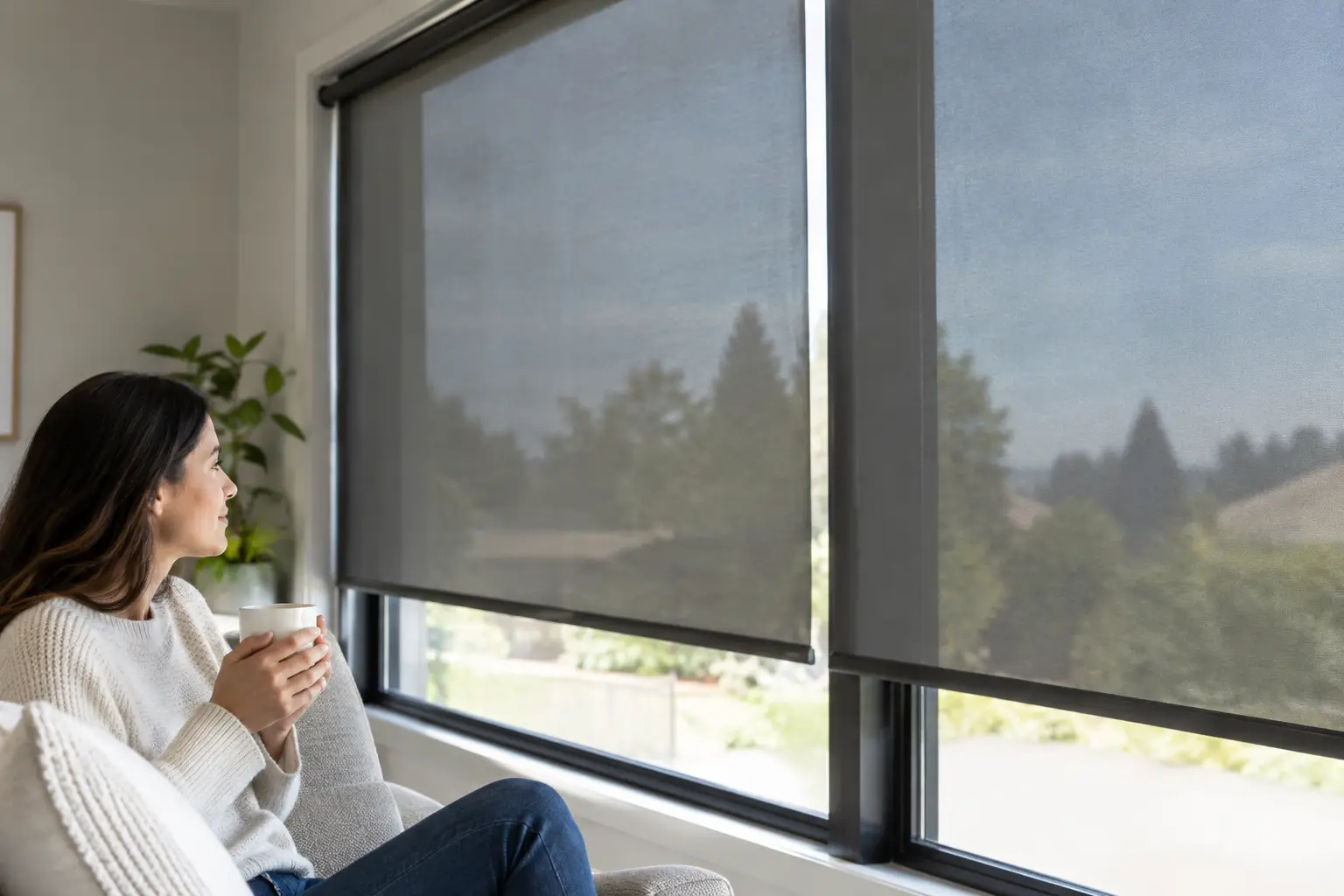
During daylight hours, solar shades can offer excellent privacy from the outside looking in. The fabric is designed to reduce glare, soften sunlight, and limit visibility into the room while still allowing occupants to see outward.
This works because the outdoor side is typically brighter than the interior. When people outside are looking toward a sunlit window, the solar shade makes it difficult to distinguish people, furnishings, and activity inside. From indoors, however, you can often retain a filtered view of the landscape, skyline, or backyard.
The effect is especially useful in urban homes and condominiums, where windows may face nearby buildings. A properly selected solar fabric can make a room feel open rather than closed off, while adding a meaningful layer of daytime discretion.
Privacy is not absolute, though. At very close range, silhouettes and movement may still be visible, particularly with a more open weave. If a window faces a neighbor only a few feet away, consider a tighter fabric or a second window treatment for periods when more coverage is needed.
Why Solar Shade Privacy Changes at Night
At night, the lighting relationship reverses. Interior lights make your home brighter than the exterior, which means people outside can see toward the illuminated window more easily. A solar shade will still diffuse the view, but it usually will not create the complete nighttime privacy that many homeowners expect.
Think of a solar shade as a screen rather than a solid barrier. It reduces visibility and obscures details, but depending on the fabric and lighting, someone outside may see shapes, movement, and silhouettes. The stronger the lights inside and the darker it is outdoors, the more noticeable this effect becomes.
This does not make solar shades a poor choice. It simply defines their role. They are outstanding for glare control, UV protection, view-through, and daytime privacy. For a bedroom, bathroom, nursery, or a ground-floor room facing the street, they are often best specified with a complementary privacy layer.
The Openness Factor Matters Most
Solar shade fabrics are commonly described by their openness factor, expressed as a percentage. This refers to how much open space exists in the weave. A lower percentage means a tighter weave; a higher percentage means a more open weave.
A 1% openness fabric provides the highest level of privacy and glare control within the solar shade category. It limits view-through more than a 3% or 5% fabric and is often a strong option for homes with close neighbors or intense afternoon sun. The trade-off is a more restricted view outward and a slightly more enclosed feeling.
A 3% openness fabric is often a balanced choice for residential spaces. It preserves some connection to the outdoors while providing stronger daytime privacy than a more open material. It is commonly considered for living areas, dining rooms, offices, and condo windows.
A 5% or 10% openness fabric allows a clearer view outside and can bring a lighter visual feel to the room. These fabrics are attractive where the view is the priority, but they offer less privacy. They tend to work best when a property has generous distance from neighbors or when another shade, drapery panel, or blind will be used after dark.
Fabric Color Affects What You See
Color has a real impact on both visual comfort and privacy. Dark solar fabrics generally provide a clearer view from inside during the day because they absorb more light and reduce reflected glare. For homeowners who want to enjoy a garden, cityscape, or water view, charcoal, bronze, black, and deep gray solar shades can be especially appealing.
Lighter fabrics reflect more light and can brighten the appearance of a room. They may offer a softer, less contrast-heavy look from the exterior, but the view through the shade is usually less crisp. They are often selected to coordinate with pale interiors, coastal palettes, or rooms where a light and airy appearance is the design goal.
Neither option guarantees nighttime privacy. A dark fabric may feel more visually transparent when lights are on indoors, while a light fabric can conceal details somewhat differently. The fabric’s openness and the room’s lighting are still the deciding factors. Reviewing full-size samples at the window, at different times of day, is much more reliable than judging from a small swatch under showroom lighting.
Best Ways to Add Nighttime Privacy
For rooms that need both daytime view-through and complete evening coverage, layered window treatments are usually the most successful solution. The solar shade handles sun, glare, and daytime visibility; the secondary treatment is closed when privacy is the priority.
A few pairings work particularly well:
- Solar shades with drapery panels: This is a polished choice for living rooms, dining rooms, and primary bedrooms. The solar shade maintains a clean daytime look, while lined drapery adds softness, acoustic benefit, and greater nighttime privacy.
- Dual roller shades: Two shades operate on one coordinated system, typically with a solar shade in front and a blackout or room-darkening roller shade behind it. This is an excellent solution for modern interiors, media rooms, bedrooms, and condos where space is limited.
- Solar shades with Roman shades: Roman shades bring texture and decorative presence to a room while the solar shade manages daytime glare. Depending on the fabric and lining, the Roman shade can provide strong privacy when lowered.
- Solar shades with shutters or blinds: Adjustable vanes or louvers provide flexible privacy control and can suit traditional, transitional, or tailored spaces. This combination is practical where directional light and privacy need frequent adjustment.
Motorization makes layered treatments even more useful. With systems from brands such as Lutron, Somfy, Hunter Douglas, and Graber, shades can be scheduled to lower at sunset or controlled from a wall keypad, remote, or smart-home platform. That means privacy does not depend on remembering to close every shade once the lights come on.
Room-by-Room Solar Shade Privacy Guidance
In a living room with a backyard view, a 3% or 5% solar shade may be enough during the day, especially if there are no close sightlines. Add drapery if the room is used frequently after dark or if the window faces another home.
For a street-facing kitchen or family room, a 1% or 3% solar shade often offers a better balance. You can retain daylight without leaving the room overly exposed to pedestrians and nearby traffic. If evening privacy is important, a dual-shade system gives the room more range.
Bedrooms need the most careful planning. Solar shades alone are rarely the preferred choice if privacy and sleep are priorities. Pairing a solar shade with a blackout roller shade, blackout drapery, or a lined Roman shade gives you daytime light control and dependable nighttime coverage.
Bathrooms are another area where solar shades may not be sufficient by themselves. Frosted glass, privacy film, top-down treatments, shutters, or an opaque shade may be more appropriate, depending on the window location. If you want filtered daylight without a direct view into the room, a specialist can help identify the right material and installation style.
What to Consider Before Ordering
The right solar shade is not selected by openness factor alone. Window direction, surrounding homes, landscaping, floor level, interior lighting, and the desired view all affect performance. A south- or west-facing room may need stronger solar control, while a ground-floor window near a walkway may need a more privacy-focused specification.
Custom sizing is equally important. Light gaps along the sides of an inside-mounted shade can affect privacy, especially at night. In some cases, an outside mount or a carefully planned dual-shade system provides better coverage. Fascia styles, hardware finish, roll direction, and motorization should also be considered as part of the finished design rather than afterthoughts.
At Window Fashions Depot, a consultation can help you compare fabric samples in the context of your actual room, not just a catalog image. That is often where the best answer becomes clear: a solar shade may be exactly what you need, or it may be the first layer of a more complete window treatment.
The most satisfying solar shade installations preserve the light and views you love while giving you control when privacy matters. Plan for how the room looks at noon and how it feels at 9 p.m., then select a treatment that performs beautifully in both moments.
0 comments