
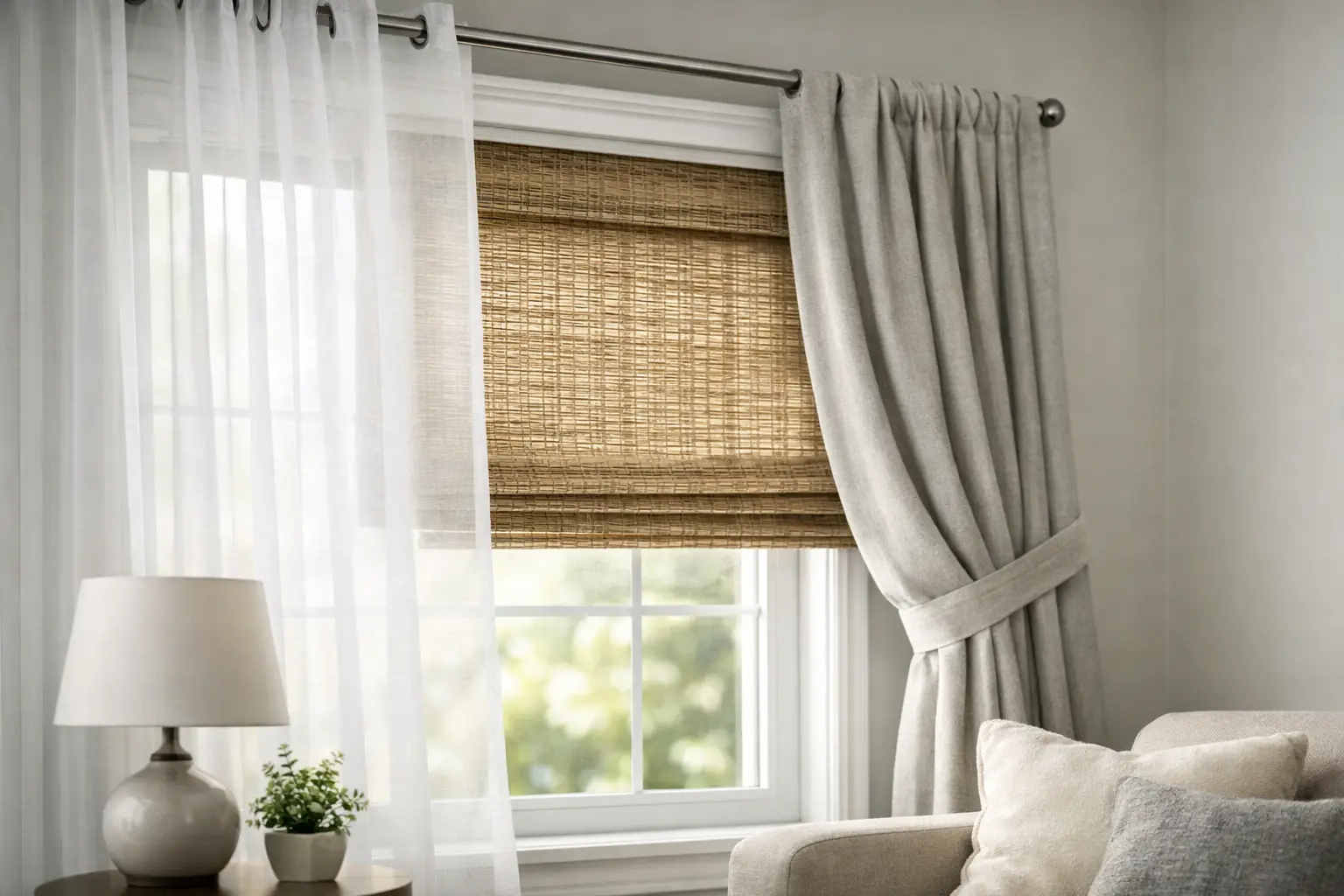
Guide to Layered Window Treatments
A window that feels unfinished usually is not missing a single product. It is missing a plan. This guide to layered window treatments is built for homeowners, designers, and renovators who want more than a basic blind – they want privacy when needed, softer light during the day, better insulation at night, and a finished look that belongs in the room.
Layering works because one treatment rarely does everything well. A solar shade can protect a view but may not give full nighttime privacy. Drapery adds softness and depth but may not deliver the precise light control a shade can. Shutters bring structure and durability, but they create a different visual weight than fabric. When you combine the right products, each one covers what the other lacks.
What layered window treatments actually mean
Layered window treatments are simply two or more window covering types used together on the same opening. The most common pairing is a shade with side panels or full drapery, but the concept can also include shutters with drapery, woven woods under drapery, or dual-function systems that mix sheer and blackout performance.
The goal is not to stack products for the sake of decoration. Good layering solves a practical problem first, then improves the room visually. In a bedroom, that problem may be early morning light. In a street-facing living room, it may be privacy without losing daylight. In a condo, it may be glare reduction and heat control without making the space feel closed off.
Why this approach works better than a single treatment
Single-layer treatments tend to force a compromise. If you choose only blackout drapery, you get darkness but lose easy daytime light filtering. If you choose only sheer shades, the room feels open but may not feel private enough at night. Layering gives you flexibility across different times of day and different seasons.
It also creates a more custom result. Even a simple roller shade looks more finished when framed by tailored drapery panels. The room gains texture, scale, and a stronger design point around the window. For larger homes, renovated main floors, and professionally designed spaces, that extra finish matters.
There is a trade-off, of course. Layering usually costs more than specifying one product, and the details matter more. Projection, stack-back, hardware placement, and fabric weight all need to be coordinated. That is why layered treatments work best when they are planned together rather than added one piece at a time.
A guide to layered window treatments by room
Living rooms and family rooms
These spaces usually benefit from a light-filtering foundation with a decorative outer layer. Roller shades, Roman shades, woven wood shades, and sheer shades are common starting points because they manage sunlight without making the room feel heavy. Drapery then adds softness, frames the window, and can introduce pattern, color, or a more architectural line.
If the room gets strong afternoon sun, solar shades can be especially useful under drapery. They reduce glare and help protect furnishings while preserving much of the view. If privacy is a bigger concern than view, a light-filtering roller or Roman shade may be the better choice.
Bedrooms
Bedrooms are usually where layering proves its value fastest. A blackout shade paired with drapery gives better sleep performance than either product alone in most cases. The shade handles core light blocking at the glass, while drapery helps reduce edge light and gives the room a more finished, quieter look.
This is one of those it depends situations. If the room has shallow trim or limited space above the window, a compact roller shade may fit better than a fuller Roman shade. If the design direction is softer and more decorative, Roman shades with lined drapery can be worth the extra visual presence.
Dining rooms and formal spaces
Layering in these rooms is often more about mood and proportion than total privacy. Woven woods with drapery create warmth and texture. Roman shades with side panels feel tailored and balanced. Shutters with drapery can work in traditional or transitional interiors where structure matters as much as softness.
Because these rooms are often viewed from adjoining spaces, the visual finish is especially important. Fabric selection, hardware scale, and how high the drapery is mounted all affect the final result.
Bathrooms and kitchens
These spaces usually call for restraint. Layering can work, but only if moisture, cleanup, and clearance are considered. A faux wood blind or moisture-resistant shade may be practical on its own, while a simple valance or stationary panel adds softness without creating maintenance issues. Full drapery is often less suitable near sinks, cooktops, or high-humidity zones.
The best product pairings to consider
A roller shade with drapery is one of the most versatile combinations. It suits modern, transitional, and many contemporary interiors. The shade keeps the look clean and functional, while drapery introduces scale and softness. This pairing also works well with motorization.
A Roman shade with drapery feels more decorative and layered by nature. It adds dimension even when the drapery stays open. This can be a strong choice for bedrooms, dining rooms, and spaces where fabric detail matters.
Woven wood shades with drapery bring texture that painted surfaces and hard flooring often need. They are popular in relaxed transitional interiors and can warm up condos or newer homes that feel visually crisp. The main consideration is light control, since woven materials vary widely in privacy and lining options.
Shutters with drapery are more specialized but very effective in the right setting. The shutters provide permanent structure, privacy, and tilt control, while drapery softens the frame and adds height. This works best when the room has enough wall space so the combination does not feel crowded.
Design details that make or break the result
Scale matters. On tall windows, narrow drapery panels can look undersized even if the fabric is beautiful. On smaller windows, oversized hardware and heavy pleats can overwhelm the opening. The right proportion is what makes a layered installation feel intentional rather than added on.
Mounting height is another major factor. Drapery installed higher and wider than the window can make the room feel taller and the opening feel larger. But this only works if the inner treatment is planned to align with it. A shade mounted too low under elevated drapery can create an awkward break.
Fabric selection should also respond to the base treatment. If the shade has visual texture, such as woven wood, the drapery may be better in a simpler fabric. If the base shade is clean and minimal, the drapery can carry more pattern or softness. Good layering usually balances contrast rather than repeating the same note twice.
Function comes first: privacy, light, energy, automation
The best layered scheme starts with the performance need. If privacy is the issue, choose the inner layer based on the level of opacity required. If glare is the issue, think first about solar fabrics, screen percentages, and window orientation. If insulation matters, cellular shades or lined drapery may deserve priority.
Motorization is often worth considering when layering is part of a larger home upgrade. Automated roller shades under decorative drapery offer a clean way to manage light without handling fabric daily. For wide windows, hard-to-reach openings, and smart-home projects, this can make the treatment more usable, not just more advanced.
When custom specification matters most
Layered window treatments are less forgiving than single-product installs. Measuring has to account for brackets, returns, clearance, and how each layer operates. This is especially true for bay windows, corner windows, oversized patio doors, and homes mixing multiple treatment types across open-plan spaces.
Custom specification also helps when you want consistency from room to room without making every window identical. A home can use blackout layering in bedrooms, solar control in the living area, and moisture-resistant solutions in baths while still maintaining a cohesive design language.
For homeowners and trade professionals working on larger projects, showroom guidance can shorten the decision process. Seeing fabrics, shade materials, hardware finishes, and operating systems together often reveals combinations that look right on paper but not in person, or the opposite. That is where a full-service source like Window Fashions Depot brings real value.
Layered treatments work best when they are treated as part of the room, not an afterthought at the end of a renovation. If you start with how the space needs to perform and then build the design around that, the finished window will feel quieter, smarter, and far more complete every day you live with it.