
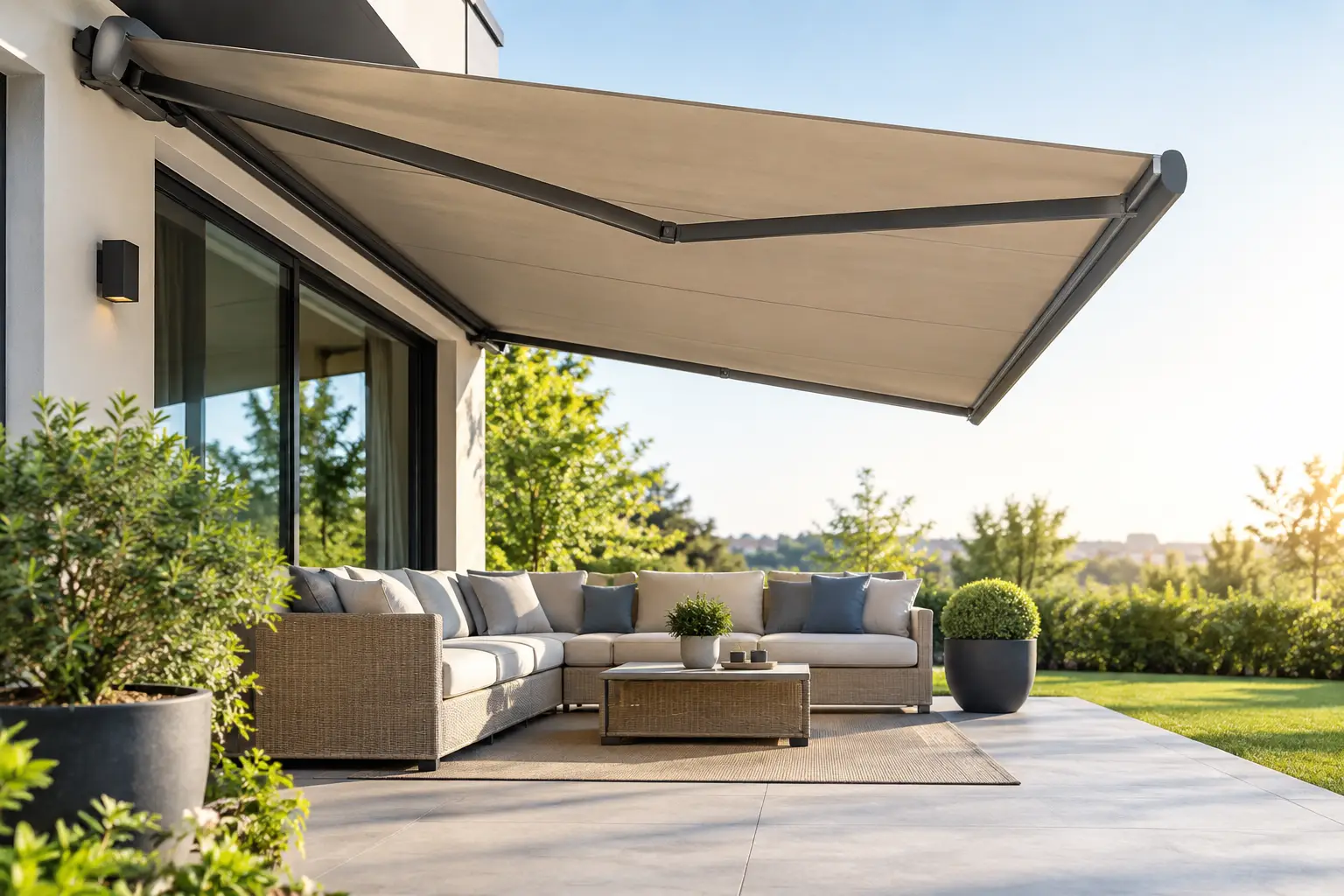
Automated Awning Guide for Smarter Outdoor Shade
A patio can be perfectly furnished and still go unused at noon because the sun reaches farther than expected. An automated awning guide starts with that practical problem: creating shade when you need it, then retracting it when you want an open sky. For homeowners, designers, and builders, the right motorized awning adds comfort, protects outdoor finishes, and gives a façade a more finished, intentional appearance.
The best system is rarely the biggest model or the one with the most app features. It is the awning specified for your wall structure, sun exposure, wind conditions, preferred seating area, and control habits. A custom consultation helps connect those details before the awning is ordered and installed.
What an automated awning does differently
A manual retractable awning is effective, but it depends on someone being present to operate it. An automated model uses a tubular motor inside the roller tube, allowing the awning to extend and retract by wall switch, handheld remote, app, timer, or compatible smart-home system.
That convenience has real value on west-facing patios, pool decks, and balconies where conditions change quickly. You can extend the awning before afternoon heat reaches the space, retract it when leaving home, or set a preferred position for regular use. For larger awnings, motorization is also the more practical choice. The fabric, front bar, and articulated arms create substantial weight that is not ideal for frequent hand cranking.
Automation does not remove the need for care. A retractable awning is a sun-shading system, not a roof engineered for heavy rain, snow, or high winds. Its controls should make responsible use easier, particularly when paired with a properly selected wind sensor.
Start with the outdoor space, not the motor
The first specification is the shading goal. Consider where people sit, where the grill is located, and when direct sunlight becomes uncomfortable. A shallow projection may shade a doorway, while a dining table or lounge area often needs greater projection. Wider is not automatically better if the seating zone is concentrated in one area or if the wall has obstructions.
Measure the mounting wall carefully. Retractable awnings can be mounted to suitable wall surfaces, soffits, or roof structures, but every installation depends on solid structural attachment. Brick veneer, stucco, siding, and exterior insulation systems may require specialized brackets and fasteners. The mounting surface must be evaluated rather than assumed to be adequate.
Projection also affects clearance. The front bar descends as the awning extends, and the pitch must direct light rain away from the wall while preserving headroom near the outer edge. On a balcony or compact urban patio, those dimensions can determine whether a standard model works or whether a more specialized system is needed.
Fixed width, adjustable shade
Most retractable awnings are manufactured to a custom width and projection. Once installed, their lateral coverage is fixed, but their extension can be adjusted from fully retracted to fully open. This gives the space flexibility throughout the day without permanently darkening adjacent rooms.
For broader outdoor areas, multiple coordinated awnings can be a better solution than one oversized unit. This can create separate zones for dining and lounging, provide more control over shade, and work around doors, columns, or uneven wall sections.
Choosing controls for an automated awning
The simplest configuration is a dedicated wall switch. It is dependable, easy for guests to understand, and does not rely on a phone or internet connection. A handheld remote adds convenience from the patio, kitchen, or living room. Multi-channel remotes are useful when several awnings, screens, or exterior shades are controlled independently.
Smart controls add scheduling and remote access. Depending on the motor and control platform, an awning may be integrated with systems from Somfy, Lutron, or other compatible smart-home ecosystems. That can be useful for a regular schedule, such as extending shade during the hottest afternoon hours or retracting the awning before bedtime.
App control should be viewed as an added layer, not the sole reason to select a system. A physical control remains valuable during phone changes, Wi-Fi interruptions, or when a family member simply wants one clear button for open and close.
Sensors are protection, not decoration
A wind sensor is one of the most valuable additions for a motorized retractable awning. When wind reaches the programmed threshold, the system retracts automatically. This helps protect the fabric and arms when weather changes while no one is nearby.
Sensor placement and settings matter. A sheltered backyard may need different calibration than an exposed rooftop terrace. Trees, neighboring buildings, and local wind patterns affect how gusts move through the space. No sensor can guarantee protection in every condition, so users should still retract the awning when severe weather is forecast.
Sun sensors can extend an awning when bright sunlight reaches a set level. They are helpful for regularly used outdoor rooms, but they require thoughtful setup. If an awning extends when no one is home, wind protection must be part of the same system. Rain sensors can be useful in specific applications, though light rain is not necessarily a reason to extend a retractable awning.
Fabric selection shapes comfort and appearance
Awning fabric does more than determine color. It influences glare reduction, heat control, privacy, view-through, and the way the exterior complements the home’s architecture. Solution-dyed acrylic fabrics are a popular choice for retractable awnings because they offer color depth, weather resistance, and a softer textile look. Performance fabrics are available in solids, stripes, textured neutrals, and more architectural patterns.
Darker fabrics generally reduce glare and can provide better outward visibility from beneath the awning. Lighter fabrics brighten the space and can feel airy, although they may allow more reflected light. The right choice depends on how the patio is used and the color of surrounding hardscape. A bright white stone terrace, for example, may benefit from a fabric that better controls reflected glare.
Consider the view from indoors as well. When retracted, the awning becomes a visible exterior feature near windows and doors. Coordinating its fabric and frame color with window trim, siding, brick, or existing exterior screens creates a more cohesive result.
Frame, arms, and cassette options
The mechanism behind the fabric is where quality and application fit become especially important. Retractable awnings use articulated arms with springs or cables to maintain fabric tension as the system extends. Higher-grade components are designed for consistent operation, but every model has its own maximum width, projection, and wind rating.
A standard open awning leaves the rolled fabric and mechanism more exposed when retracted. A semi-cassette provides partial protection, while a full cassette encloses the fabric and arms in a finished housing. Full cassettes are often preferred where the awning is highly visible, where cleaner lines matter, or where added protection from debris and weather is desirable.
The trade-off is budget and visual scale. A cassette system may carry a higher price and project farther from the wall when closed. On a contemporary home, that defined architectural profile can be a benefit. On another façade, a simpler design may be the better visual fit.
How to plan your automated awning installation
Professional measurement should happen before final pricing, especially for a custom unit. A site review confirms width, projection, mounting height, structural support, electrical access, clearance around gutters and lights, and whether the selected model suits the exposure.
Electrical planning deserves early attention. Some motorized systems can use a plug-in connection, while others are hardwired for a cleaner, permanent installation. A qualified installer can coordinate requirements with an electrician when needed. For new construction and major renovations, planning power at the awning location before finishes are complete can reduce visible wiring later.
Before approving an order, confirm the fabric, frame color, control method, sensor package, and cassette style. Ask how the system should be operated during wind, rain, winter conditions, and extended travel. These details are as important to long-term satisfaction as the initial appearance.
When an awning is not the right exterior shade
An automated awning is ideal for many patios, decks, and outdoor dining areas, but it is not the answer to every shading challenge. If the space needs vertical privacy from neighboring properties or late-day side sun, motorized exterior screens may be a stronger complement. If year-round overhead coverage is required, a pergola system or fixed canopy may be more appropriate.
For exposed locations with frequent strong winds, a retractable awning may have limitations that should be addressed honestly during specification. The right solution may involve a smaller projection, a different mounting approach, exterior screens, or a more substantial permanent structure.
A well-designed automated awning should feel effortless because the planning behind it was thorough. Window Fashions Depot can help translate your patio dimensions, architectural style, and preferred controls into a custom exterior shading system that looks considered and performs reliably for the way you live outdoors.