
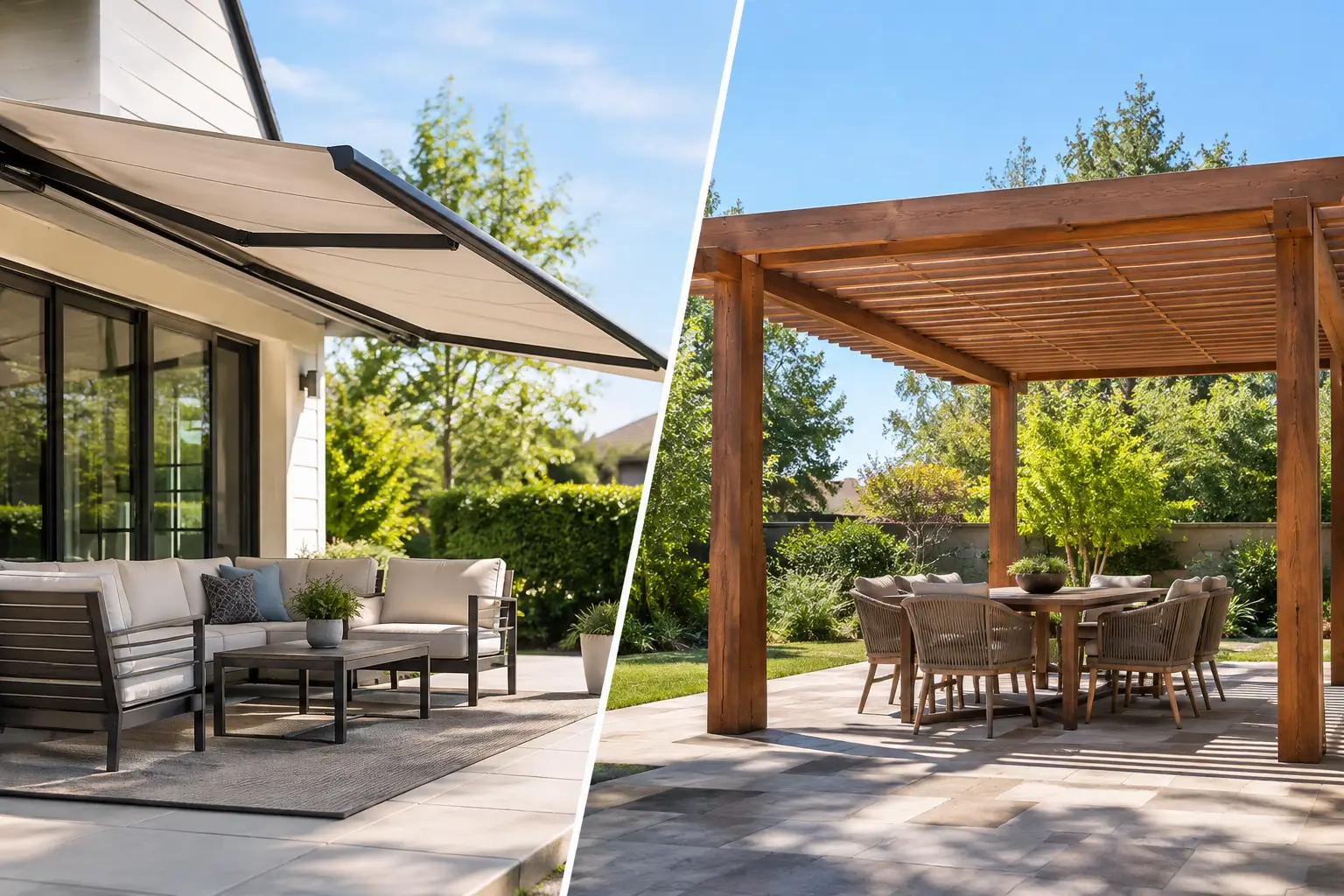
Awnings Versus Pergolas: Which Fits Your Patio?
A west-facing patio can become the best room in the house – or the space everyone avoids by midafternoon. When comparing awnings versus pergolas, the right choice comes down to more than appearance. It affects how much sun you block, whether you can use the space during light rain, how the structure relates to your home, and how much flexibility you want from one day to the next.
Both options can make an outdoor living area more comfortable and visually complete. They are not interchangeable, however. An awning is generally a shading system attached to the home, while a pergola is a freestanding or attached architectural structure that defines an outdoor room. Understanding that distinction makes it much easier to specify a solution that feels intentional rather than added on.
Awnings versus pergolas: Start with how you use the space
The most useful question is not, “Which one looks better?” It is, “What needs to happen under it?” A family that wants shade over a narrow deck and open sky in the evening has different needs than a homeowner planning an outdoor dining room, a poolside lounge, or a covered kitchen.
An awning is often the natural choice when the goal is targeted, adjustable shade directly outside a window, patio door, or terrace. A pergola generally makes more sense when the goal is to create a permanent outdoor destination with a stronger sense of enclosure and architectural presence.
What an awning does best
A retractable awning extends from the exterior wall to shade a patio, balcony, or seating area. When it is not needed, it folds neatly back toward the house, preserving sunlight indoors and an open view of the sky. This flexibility is a major advantage for homes that receive welcome sun in cooler months but need relief during the summer.
Quality awnings can be customized with frame finishes, fabric colors, valances, projection sizes, and optional motorization. Performance fabrics are available in solids, textured neutrals, and subtle stripes, allowing the awning to coordinate with exterior trim, brick, siding, or contemporary facade materials. For hot afternoon exposures, the fabric selection matters as much as the size of the system.
Awnings also work well where space is limited. They do not require posts at the outer edge, leaving the patio clear for circulation, furniture, and landscaping. On a townhouse terrace or compact urban backyard, that clean footprint can be the deciding factor.
What a pergola does best
A pergola creates a frame for outdoor life. Its posts and overhead structure establish the boundaries of a patio lounge, dining area, or garden retreat, giving an open yard a clear purpose. Even before furniture, lighting, or planting is added, a well-proportioned pergola makes the space feel more designed.
Traditional pergolas have open slats that filter light rather than fully block it. They are attractive for homeowners who enjoy dappled shade and want to support climbing plants, pendant lighting, drapery panels, or outdoor-rated screens. But open slats should not be confused with reliable rain protection or complete sun control.
For greater performance, a pergola may use an integrated retractable canopy, a fixed roof, or adjustable louvers. Louvered systems can be positioned to manage sunlight and ventilation, then closed when rain begins, depending on the system and installation. These more advanced designs can extend the usable season, but they require thoughtful planning for drainage, electrical access, wind exposure, and structural support.
Compare shade, rain protection, and flexibility
The difference between filtered light and genuine shade becomes obvious at lunchtime in July. A retractable awning with the right fabric can provide broad, dense shade over a patio while still allowing the homeowner to retract it later. It is particularly effective when the sun is coming from above and in front of the house.
A pergola with open rafters provides partial shade that shifts throughout the day. This can be beautiful, but it may not be enough for a south- or west-facing patio where heat gain is the primary problem. Adding a canopy or louvers improves coverage, although it also changes the project from a simple garden feature into a more engineered outdoor system.
Rain is another important distinction. A properly installed fixed or louvered pergola may provide meaningful shelter during a shower. A retractable awning can offer protection in light rain only when its pitch, fabric, drainage, and manufacturer guidelines allow it. It should be retracted during high winds or severe weather. Homeowners should not assume that every fabric awning is designed to carry standing water or remain extended in storms.
Flexibility favors the retractable awning. With motorization, the shade can extend at the touch of a wall switch, handheld remote, or compatible smart-home control. Sun and wind sensors can add another level of convenience by responding to changing conditions. A pergola is more permanent by nature, although louvered and retractable-roof versions offer sophisticated control within the structure itself.
Consider architecture, scale, and sightlines
An awning becomes part of the home’s facade, so its fabric and hardware should complement windows, doors, rooflines, and exterior finishes. It can soften a modern elevation, add tailored character to a traditional home, or introduce a carefully chosen accent color. The best installations look proportionate to the opening and project far enough to shade the area that people actually use.
A pergola has more visual weight. It is often the right choice for a large rear yard, a detached patio, or a home with enough architectural scale to support posts and beams. It can also be effective near a pool or outdoor kitchen, where there is no convenient wall for mounting an awning.
Sightlines deserve attention. A pergola’s posts can define a space beautifully, but they also become permanent elements in views from the kitchen, living room, or garden. An awning keeps the perimeter more open, but its mounting location and cassette size need to be considered around eaves, lights, gutters, and second-story windows.
Budget for the structure, not just the shade
Pricing varies widely because both categories range from straightforward to highly customized. A manual retractable awning is typically less complex than a fully engineered louvered pergola, but dimensions, fabric, mounting conditions, motorization, lighting, heating, and installation access all affect the final quote.
A pergola may involve footings, site preparation, drainage planning, electrical work, and permits, particularly for larger attached structures or roofed systems. Those requirements are part of the value of a permanent outdoor room, but they should be accounted for early. An awning usually has a lighter construction scope, provided the wall can safely support it and the mounting area is clear.
Maintenance should also inform the decision. Awnings benefit from seasonal cleaning and proper retraction during unsuitable weather. Pergolas require inspection of finishes, fasteners, gutters or drainage channels, and moving louver components where applicable. Wood pergolas may need more ongoing finishing than aluminum systems, while aluminum offers a cleaner, lower-maintenance contemporary look.
Choose the option that solves the real problem
Choose a retractable awning when you want adaptable shade against the house, need to preserve an open patio edge, or prefer a lower-profile solution for a deck, balcony, or smaller outdoor area. It is especially practical for dining patios where sun exposure changes during the day and for homeowners who do not want a fixed overhead structure year-round.
Choose a pergola when the priority is creating a dedicated outdoor room, anchoring a larger landscape plan, or covering an area away from the house. It is also the stronger option when posts, lighting, screens, and roof systems are part of the vision from the beginning.
There is also a middle ground. A pergola can incorporate retractable fabric panels or adjustable louvers for variable shade, while an awning can be paired with side screens to manage low-angle sun, privacy, and insects. The right specification often comes from combining the features you need rather than selecting a category based on photos alone.
Plan the details before selecting a system
Measure the usable seating or dining zone, not only the dimensions of the patio. Note the direction of the strongest sun, the height of exterior doors and windows, wind exposure, roof overhangs, and any obstacles on the wall or ground. Consider how the space will be used after dark as well. Integrated lighting, outdoor screens, and motorized controls are easier to plan before installation than to add afterward.
A design consultation can also clarify fabric opacity, frame finish, projection, drainage, and automation options. For projects involving custom awnings, pergola systems, exterior screens, and smart controls, Window Fashions Depot can help align the product specification with the home’s architecture and the way the outdoor space will be lived in.
The best shade structure does not simply cover a patio. It gives you a comfortable reason to step outside more often – whether that means pressing a button for instant shade or gathering beneath a defined outdoor room that feels like it has always belonged there.