
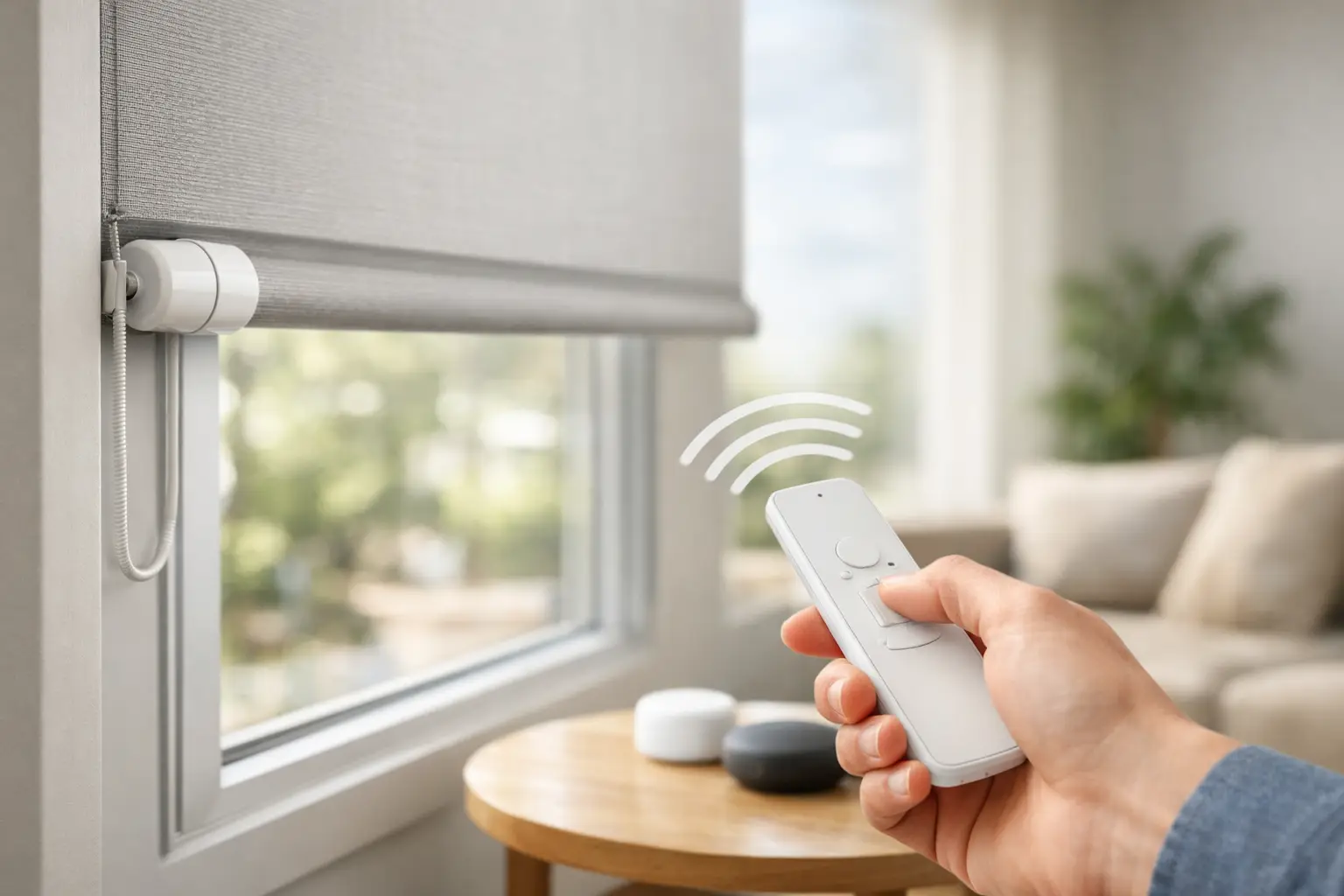
How to Automate Existing Shades
That hard-to-reach shade over the stairwell usually decides the project for people. Once one window is annoying enough to adjust by hand, the question becomes how to automate existing shades without replacing every treatment in the room. The answer depends on the shade type, the headrail design, the age of the product, and how much smart-home integration you actually want.
For some shades, retrofitting motorization is straightforward. For others, replacement is the cleaner and more reliable path. If you are planning around aesthetics as much as convenience, the goal is not just adding a motor. It is choosing a solution that preserves the look of the room, improves daily use, and fits the way the window treatment was built in the first place.
Can you automate existing shades?
Often, yes. But not every shade is a good retrofit candidate.
Roller shades, solar shades, and some cellular shades are usually the most retrofit-friendly because their operating systems are relatively simple. If the tube, clutch, brackets, and fabric are still in good shape, a motorized upgrade may be possible without changing the visible fabric. Some Roman shades and woven wood shades can also be motorized, but their lift mechanisms are more variable, so compatibility needs closer review.
Older shades with worn hardware, cord damage, sagging fabric, or nonstandard headrails can be harder to automate well. In those cases, forcing a retrofit may cost nearly as much as a replacement while delivering a less polished result. That is where a product-focused consultation matters. A good recommendation is based on how the shade performs today, not just whether a motor can technically be attached.
How to automate existing shades the right way
The first step is identifying exactly what you already have. Shade category matters, but so do the manufacturer, dimensions, mounting style, and control mechanism. A chain-operated roller shade is a different retrofit opportunity than a cord-lock Roman shade or a top-down bottom-up cellular shade.
Measurements also matter more than many homeowners expect. Motor size, battery tube clearance, bracket spacing, and header depth all affect whether the upgrade will sit neatly inside the opening or require visible adjustments. For designers and builders, this is often the point where a site-specific recommendation saves time. Two windows that look identical from across the room may need different motorization strategies once the hardware is inspected.
Then comes the control decision. Some clients want a simple remote so they can raise multiple shades at once. Others want app control, voice integration, timers, or scenes that coordinate with lighting and temperature management. The more connected the system, the more important it is to choose components that are known to work well together over time.
Retrofit motorization vs replacing the shade
A retrofit sounds appealing because it suggests keeping what you already own. Sometimes that is absolutely the smartest move. If the shade fabric still suits the room, the fit is correct, and the hardware is in strong condition, retrofitting can preserve your design while adding modern convenience.
Replacement makes more sense when the shade is already dated, the fabric has faded, or the operating system was never especially smooth to begin with. It can also be the better value if you want features your current product cannot support well, such as quieter performance, cleaner fascia options, rechargeable battery systems, or more refined control integration.
There is also a visual trade-off to consider. Some retrofits are almost invisible. Others may introduce a slightly bulkier headrail, an exposed charging point, or hardware that does not match the original finish perfectly. In a secondary bedroom, that may be acceptable. In a carefully designed living room or a full-home renovation, replacement often delivers the more cohesive result.
Common ways to automate existing shades
Most retrofit projects fall into one of three paths: internal motors, add-on drive systems, or full headrail replacement.
Internal motors are the most elegant option when the shade construction allows it. These fit inside a roller tube or compatible lifting system and keep the appearance clean. They are commonly used for roller and solar shades and can be battery-powered, rechargeable, or hardwired depending on the system.
Add-on drive systems are more visible but can work when replacing the internal mechanism is not practical. These solutions are often used on chain-driven shades. They can be a good fit for convenience-focused upgrades, though they may not have the same custom look as a purpose-built motorized shade.
Full headrail replacement is the middle ground between retrofit and full replacement. In some cases, the fabric can be retained while the operating hardware is upgraded to a new motorized assembly. This can be a strong option when the fabric is worth saving but the original mechanics are not.
Power options: battery, rechargeable, or hardwired
Power choice affects both installation and long-term satisfaction.
Battery-powered motors are popular because they reduce the need for electrical work. They are especially practical in finished homes, condos, and spaces where opening walls is not desirable. Depending on window size and usage, battery life can be quite good. The trade-off is maintenance. At some point, batteries need to be replaced or recharged, and that can be inconvenient on tall or hard-to-reach windows.
Rechargeable motors offer a cleaner ownership experience for many households. Instead of replacing disposable batteries, you recharge the unit periodically. For the right applications, this is a very attractive balance of convenience and clean installation.
Hardwired motorization is often preferred in new construction and major renovations. It supports frequent use well and removes the need for battery maintenance. It also requires planning. If wiring is not already in place, labor and wall access become part of the decision.
Smart controls and automation features
Once clients start looking into how to automate existing shades, they often realize the motor is only part of the upgrade. Control experience matters just as much.
Remote controls remain a favorite because they are simple and reliable. Grouping several shades on one channel can make a large room much easier to manage. Wall switches add a built-in feel that many homeowners and designers prefer, especially in primary bedrooms, media rooms, and open-concept living areas.
App-based control is ideal for scheduling and remote access. You can set shades to lower during peak afternoon sun, raise with your morning routine, or create scenes for entertaining and privacy. Voice assistant compatibility can be useful too, but only if the rest of the home already uses that ecosystem. If not, a dedicated remote or wall control may be the better everyday solution.
When a professional assessment is worth it
Motorizing existing shades is one of those projects that sounds simple online and becomes highly specific once measurements and hardware are involved. Fabric weight, bracket condition, tube diameter, stack height, and mounting depth all affect what will work.
This is especially true for custom homes, layered window treatments, oversized windows, and designer-selected fabrics that you do not want to compromise. An expert review can clarify whether a retrofit is advisable, whether a replacement will look better, and which brands and systems best match the room’s performance needs.
For homeowners in Toronto and the GTA, this can be particularly helpful in condos and urban homes where window access, glare control, privacy, and clean design lines all matter at once. A showroom-backed recommendation tends to account for more than the motor alone. It considers the visual finish, the daily routine, and the long-term serviceability of the system.
What to expect from the process
A typical project starts with identifying the existing shades and evaluating compatibility. From there, the recommendation usually narrows to retrofit, partial replacement, or full replacement. Then the control system, power source, and finish details are selected.
Lead time depends on whether parts are available for the current shade system or whether new custom components need to be ordered. Installation can be relatively quick for straightforward retrofits, while more integrated solutions may involve programming, grouping, and final adjustment.
If you are updating multiple rooms, it is smart to think in terms of the whole home rather than one window at a time. That does not mean motorizing everything immediately. It means choosing a control platform and product direction that can expand logically later.
The best motorized upgrade is not always the least expensive path up front. It is the one that fits the shade properly, looks intentional, and works reliably every day. If your current treatments are worth keeping, automation can extend their usefulness in a meaningful way. If they are already nearing the end of their run, a replacement may give you a cleaner design, better performance, and a result that feels planned rather than patched together.