
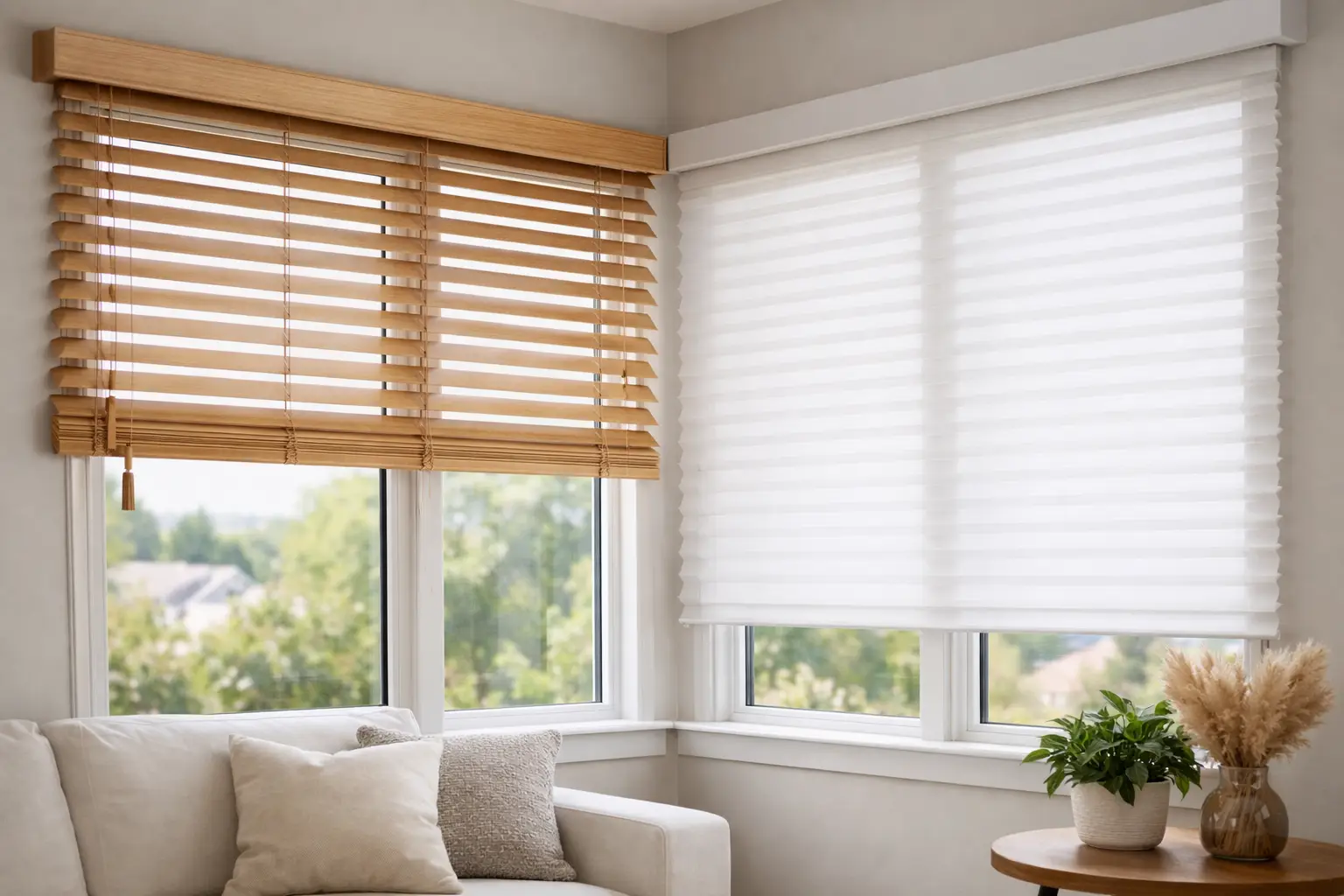
What Blinds Work Best for Corner Windows?
A corner window can make a room feel brighter, larger, and more architectural, but it also creates a treatment challenge: two panes of glass meet where there is little or no wall for mounting hardware. If you are asking what blinds work for corner windows, the best answer is usually a coordinated pair of custom treatments, specified as a system rather than as two unrelated windows.
The right choice depends on the corner itself, the depth of the window frame, how much privacy you need, whether the windows open, and how visible the treatment will be from the main living area. A well-planned installation keeps light gaps controlled, preserves access to the glass, and gives both sides of the corner a deliberate, finished appearance.
Start With the Corner Window Configuration
Not all corner windows are built alike. In many homes, two separate windows meet at a 90-degree interior corner with trim between them. In others, the glass turns the corner with minimal framing, creating a nearly uninterrupted view. Bay-style corners, angled windows, and floor-to-ceiling glazing each require their own approach.
The first decision is whether each window can receive its own inside-mounted treatment. If the frames have adequate mounting depth, two independently operated shades or blinds often provide the cleanest solution. Each treatment can be raised, lowered, tilted, or adjusted without affecting the other side.
When trim is narrow, the corner is very tight, or the window lacks sufficient recess, an outside mount may be more practical. This places the headrail or shade hardware above the opening, allowing the coverings to overlap slightly and reduce the exposed gap at the corner. The trade-off is that outside-mounted treatments become a more noticeable design element, so fabric, cassette style, and bracket placement matter more.
Before selecting a product, a professional should assess frame depth, trim projection, sill clearance, window handles, crank mechanisms, and the direction each sash opens. These details determine whether a product will operate freely after installation.
Roller Shades for Clean, Modern Corners
Roller shades are among the strongest options for contemporary corner windows. Their compact profile, broad fabric selection, and simple horizontal lines work especially well in condos, living rooms, kitchens, and rooms with expansive views.
Two roller shades, one on each window, can be aligned at the same height so they read as a cohesive installation. Light-filtering fabrics soften glare while maintaining daytime views; room-darkening and blackout fabrics provide stronger privacy and sleep control. Solar screen fabrics are particularly effective on sun-facing corners, where the issue is often heat and glare rather than complete darkness.
There will usually be a narrow light gap between two independently mounted roller shades. That is normal, particularly where mounting brackets and fabric rolls need clearance. Careful measurement can minimize it, and an outside mount can allow strategic overlap. If the corner faces a neighboring property or a street, consider adding side panels or drapery to improve nighttime privacy.
Motorized roller shades are an excellent upgrade for hard-to-reach corners or rooms with multiple windows. A single scene can lower both shades together for evening privacy, while still allowing individual adjustment when one side receives stronger sun.
Cellular Shades When Insulation Matters
Cellular shades, also called honeycomb shades, are a practical choice for corner windows in bedrooms, offices, and rooms that run hot in summer or cool in winter. Their honeycomb-shaped cells trap air, helping reduce heat transfer through the glass.
For a corner installation, two cellular shades can be custom-sized to meet neatly at the intersection. Their soft, tailored appearance feels less minimal than a roller shade but more streamlined than fabric drapery. They are available in light-filtering and blackout opacities, including top-down/bottom-up designs that bring in daylight while keeping lower portions of the window covered.
The main consideration is stack height. Cellular shades gather into a relatively compact stack, but the stack is still visible when the shade is fully raised. On a corner with a dramatic view, select a cell size and operating system that preserve as much glass as possible.
Roman Shades for a Softer Design Statement
Roman shades bring fabric texture, color, and a more decorative look to corner windows. They work beautifully in dining rooms, primary bedrooms, sitting rooms, and traditional or transitional interiors where the windows should feel integrated with the furnishings.
A matched pair of Roman shades can frame a corner gracefully, especially when the same fabric repeats on both windows. Flat Roman shades create a crisp profile, while relaxed or softly folded styles add more visual depth. Lined fabrics improve privacy, and blackout linings are available for bedrooms.
Roman shades are not always the best choice for a very tight inside corner. Their fabric folds and headrails need room to operate, and slight separation between the two sides is expected. They are most successful when the room benefits from their texture and the corner is not intended to be completely gap-free.
Horizontal Blinds and Sheer Shadings
Horizontal blinds in wood, faux wood, or aluminum can work for corner windows when adjustable light direction is the priority. Tilting the slats lets you manage sun while maintaining some outward visibility, which is useful in kitchens, family rooms, and street-facing spaces.
Faux wood blinds are often preferred in humid areas because they resist warping and are easy to clean. Real wood offers a warmer, more furniture-like finish but may not be ideal for high-moisture rooms or intense direct sun. For either material, coordinate slat size, valance style, and mounting height across both windows so the corner feels balanced.
Sheer shadings offer another refined option. Their soft fabric vanes sit between sheer panels, diffusing harsh daylight when open and providing greater privacy when closed. They suit polished living spaces but require a bit more depth than a basic roller shade, making precise measuring essential.
Shutters Create a Built-In Corner Detail
Custom shutters are a premium, architectural solution for corner windows. Rather than treating the corner as an awkward interruption, shutters can turn it into a framed design feature. Panels are built to the opening, with louvers that tilt for light control and privacy.
In a 90-degree corner, shutters can be engineered with a corner post or specialized joining detail, allowing both sides to look intentional and structurally integrated. They are durable, easy to maintain, and particularly effective in kitchens, bathrooms, and high-traffic family spaces.
Their trade-off is visual weight. Shutters become a permanent part of the room’s architecture, so they are best for interiors that suit their crisp lines and substantial presence. They also require accurate assessment of window depth and operable sash clearance before ordering.
When Drapery Is the Better Answer
Some corner windows need more than blinds alone. Full-height drapery can soften a glass-heavy room, improve acoustics, add insulation, and cover the small gaps that are unavoidable with independent shades.
A corner track or two carefully joined rods can carry panels around the corner, creating a continuous treatment across both walls. This is especially effective for large windows, patio-adjacent corners, and formal living spaces. Combining drapery with roller shades, cellular shades, or sheer shadings gives you flexible daytime light control and stronger nighttime coverage.
For tight corners, drapery hardware needs planning. A standard rod may leave an awkward break at the intersection, while a properly specified corner connector or bent track allows panels to travel closer to the corner. This is one area where custom hardware makes a visible difference.
What Blinds Work for Corner Windows With Privacy Needs?
For bedrooms, bathrooms, and windows facing close neighbors, prioritize coverage before focusing on the smallest possible stack. Blackout roller shades, blackout cellular shades, lined Roman shades, and shutters all offer strong privacy when properly fitted.
If the corner has direct sightlines from outside, ask about side channels, outside mounting, wider fabric widths, or layered treatments. Two inside-mounted blinds may look exceptionally clean, but they can leave narrow side and center gaps. Layering a shade with drapery is often the most effective way to improve privacy without giving up daylight control.
For living rooms with daytime privacy concerns, solar shades or light-filtering cellular shades can limit inward views while still keeping the space bright. At night, however, most light-filtering fabrics reveal silhouettes when interior lights are on. A second layer is worth considering.
Measurement and Installation Make the Difference
Corner windows are not a good place to rely on a single width measurement or an off-the-shelf blind. The two treatments must account for bracket clearance, headrail dimensions, fabric roll direction, and how closely the coverings can approach one another without rubbing.
A consultation is especially valuable when the windows are oversized, angled, motorized, near cabinetry, or part of a full-room design plan. Window Fashions Depot can help specify coordinated treatments, from dual roller shades and honeycomb systems to custom shutters, Roman shades, and automated controls.
The most successful corner window treatment is rarely the one that simply fits the glass. It is the one that respects the architecture, solves the room’s light and privacy needs, and still looks considered when both sides of the corner are in full view.