
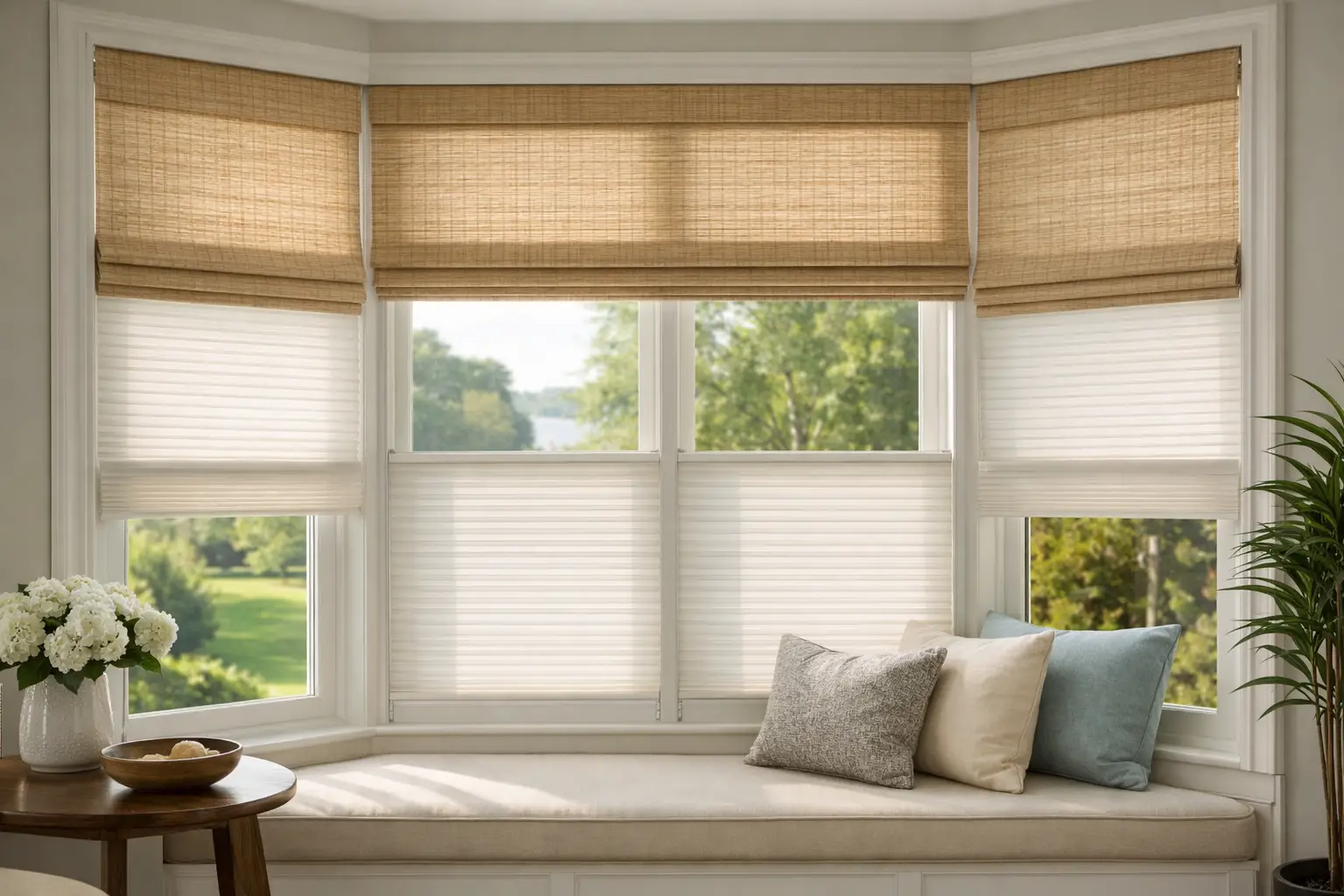
Best Shades for Bay Windows That Fit Beautifully
A bay window earns its place in a room by bringing in generous daylight, opening up a view, and adding architectural character. It also creates a more involved window-covering decision than a standard flat window. The best shades for bay windows must work across three or more angled openings while preserving the clean geometry that makes the bay attractive in the first place.
The right choice depends on how you use the room. A street-facing living room may need privacy without losing daytime light. A breakfast nook may call for easy operation around seating. In a bedroom, room darkening and insulation can take priority. Custom shades allow each section of the bay to be measured, specified, and controlled as part of one intentional design.
Why Bay Windows Need a Custom Approach
A bay window is usually made up of a large center panel and two smaller angled side panels. Even when the windows appear symmetrical, their dimensions, sill depth, trim, and operating clearance can differ. Treating the entire bay like one broad opening often produces awkward gaps, difficult operation, or a look that obscures the window’s shape.
Individual shades fitted to each opening are generally the most polished solution. They follow the angles of the bay, provide more precise light control, and let you adjust one section when sunlight moves across the room. This is especially useful when the center window faces a different direction than the side windows.
Mounting details matter as much as shade style. Inside-mounted shades offer a tailored appearance when each window has sufficient recess depth. Outside mounts can be the better choice when frames are shallow, uneven, or obstructed by handles. A professional measure identifies whether the shade brackets and fabric roll will clear neighboring panels when raised.
The Best Shades for Bay Windows by Priority
Cellular shades for insulation and flexible privacy
Cellular, or honeycomb, shades are one of the strongest all-around choices for bay windows. Their pleated cells trap air near the glass, helping reduce heat gain in sunny rooms and heat loss during colder months. Because bay windows expose more glass at multiple angles, that added insulation can be meaningful.
They are available in light-filtering, room-darkening, and blackout-oriented fabrics, making them adaptable for living rooms, bedrooms, and home offices. Top-down/bottom-up operation is particularly useful in a bay: lower the shade from the top to admit daylight while maintaining privacy along the lower portion of the glass.
The trade-off is visual. Cellular shades have a clean, contemporary profile, but they do not offer the texture or soft drape of fabric-forward treatments. They are ideal when performance, a compact stack, and a crisp look are the main goals.
Roller shades for a clean, modern finish
Roller shades suit bays with modern trim, streamlined furnishings, or a view worth preserving. When raised, they stack neatly at the top of each panel, leaving the window architecture visible. When lowered, their simple flat fabric creates an orderly, consistent plane across the bay.
Fabric selection changes the result dramatically. Solar screen fabrics filter glare and UV exposure while retaining a degree of outward visibility during the day. Light-filtering rollers soften daylight, while blackout fabrics provide more privacy and light control. For rooms that need both daytime view-through and nighttime privacy, dual roller shades place two fabrics on one coordinated system.
Roller shades do need thoughtful specification in angled bays. The fabric roll and bracket placement must be planned so shades do not interfere with each other at the corners. Cassette headrails and coordinated hardware can make separate shades look like a unified installation.
Roman shades for softness and tailored style
Roman shades bring fabric texture and a more decorative presence to a bay window. They are an excellent option when the bay is a focal point in a formal living room, dining room, or primary bedroom. Flat Romans look crisp and tailored, while soft-fold styles add more dimension.
A custom Roman shade can coordinate with upholstery, drapery panels, wall color, or accent fabrics without overwhelming the window. Lining options improve privacy and light control, and room-darkening linings are available when needed.
The primary consideration is stack height. Roman shades do not disappear as compactly as roller or cellular products when raised. On a bay with limited space above the openings, the stacked fabric may cover more glass than expected. This does not rule them out, but it makes accurate measuring and fabric selection essential.
Woven wood shades for organic texture
Woven wood shades add warmth to bays in transitional, coastal, natural-modern, and layered interiors. Materials such as bamboo, grasses, reeds, and woven fibers create texture that standard shade fabrics cannot replicate. They work especially well in dining areas and living spaces where the goal is atmosphere as much as light control.
Because natural weaves vary in openness, privacy and sunlight filtering can vary too. A privacy or blackout liner makes woven shades more practical for nighttime use and improves consistency from the street. Without a liner, they are best for rooms where a softened, filtered-light effect is welcome.
Sheer shades and layered solutions for changing light
For bays facing strong afternoon sun, sheer shades can soften glare while maintaining an airy appearance. Their adjustable fabric vanes offer more control than a fixed sheer and can be tilted to direct light away from seating or screens. They are a refined choice for contemporary living rooms and view-oriented spaces.
Layering is another effective route. A light-filtering shade on each window can handle everyday privacy and UV control, while stationary drapery panels frame the outer edges of the bay. This approach adds softness without placing bulky fabric between every angled panel. It also lets the shades do the functional work while the drapery completes the design.
Choose Operation That Matches the Bay’s Use
Cordless operation is a practical baseline for many homes, particularly when children or pets are present. It keeps the window area cleaner and avoids cords hanging across a seating nook or countertop.
Motorized shades are especially compelling for bay windows because three separate shades can otherwise mean multiple daily adjustments. With motorization from systems such as Somfy or Lutron, shades can be raised and lowered together, grouped by room, or scheduled around changing sun exposure. This is valuable for tall bays, furniture-blocked windows, and hard-to-reach locations.
Automation should serve the room, not just the technology. In a living room, a programmed afternoon setting can reduce glare and protect furnishings. In a bedroom, blackout shades can lower at night and rise gradually in the morning. Battery-powered options often suit retrofit projects, while wired systems may make sense during construction or a larger renovation.
Details That Make the Installation Look Finished
Color consistency is important, but perfect sameness is not always the objective. Matching fabric across all panels creates a calm, architectural look. Choosing a slightly more decorative treatment on the center window can work when the bay is large enough and the room supports a stronger focal point.
Consider what the shades look like from outside as well. Many communities and condominium buildings favor a consistent street-facing appearance. Neutral backing materials can help maintain a coordinated exterior view while allowing the room-facing fabric to suit your interior.
Also account for handles, window cranks, deep sills, and the furniture placed in front of the bay. A shade that looks right on a sample board may be inconvenient if its lift system cannot be reached over a banquette or behind a sofa. These are the details that separate a good product choice from a successful custom installation.
Start With the Window, Then Build the Design
Before selecting fabric, decide what the bay must do at different times of day: preserve a view, block glare, protect privacy, improve insulation, or create a softer decorative finish. Bring those priorities to a consultation along with photos of the bay, adjacent furnishings, and any nearby doors or built-ins.
At Window Fashions Depot, a custom measure helps translate those priorities into the right product, mounting method, fabric openness, and control system. The most satisfying bay window treatments do not flatten or fight the architecture. They make the window easier to live with while allowing its shape, light, and view to remain part of the room.
0 comments