
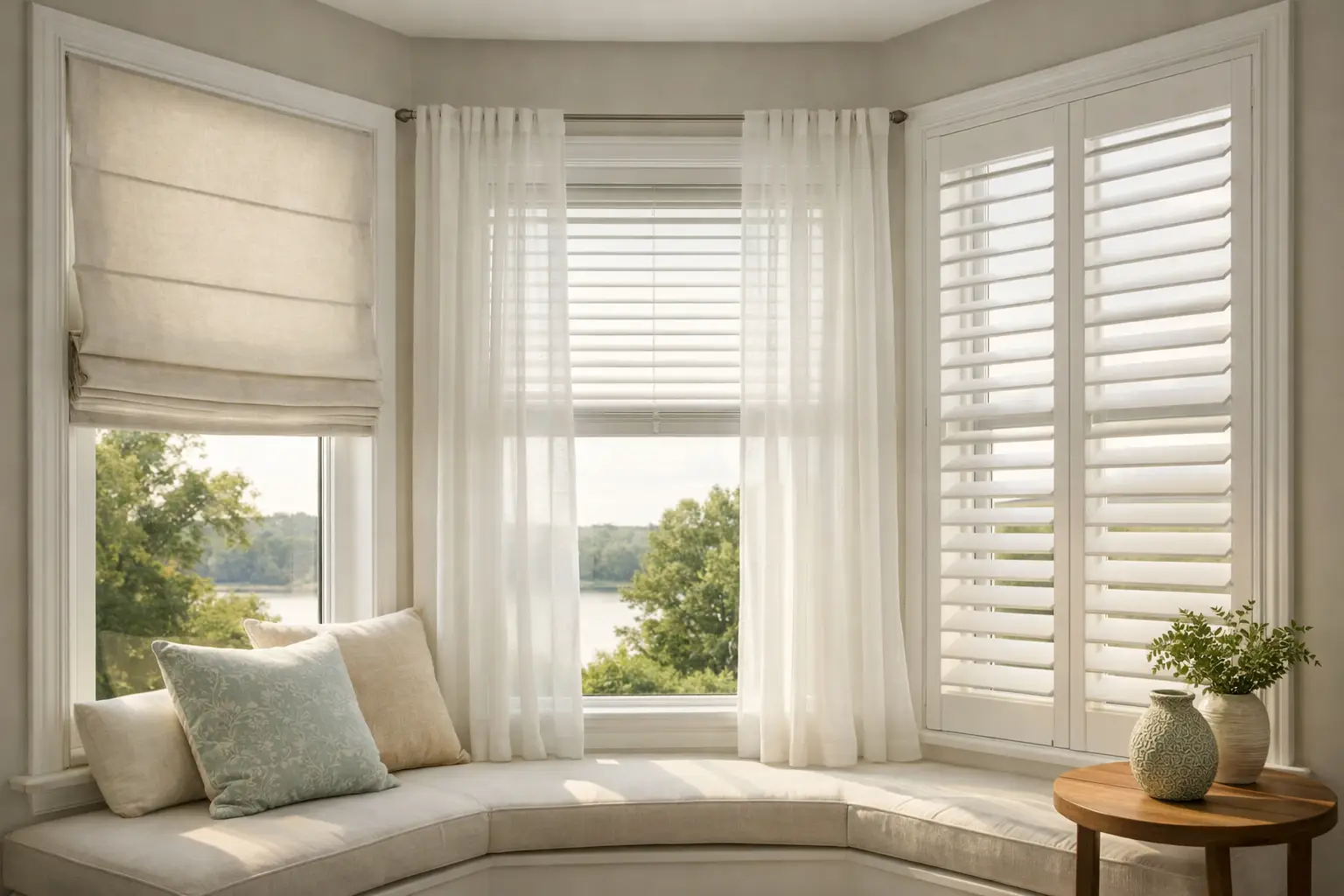
Best Window Treatments for Bay Windows
Bay windows can make a room feel larger, brighter, and more architectural – but they also create one of the trickiest spots in the house to cover well. The right window treatments for bay windows need to do more than look good from across the room. They have to account for angles, depth, individual panes, hardware placement, privacy needs, and how the space is actually used day to day.
That is why bay window projects rarely have a one-size-fits-all answer. A formal living room with a street-facing bay has very different needs than a breakfast nook, primary bedroom, or condo sitting area. The best result usually comes from balancing three things at once: the shape of the bay, the function of the room, and the design style you want the treatment to support.
What makes bay windows harder to treat
A standard flat wall gives you one plane to measure and one opening to cover. A bay window gives you a series of connected windows set at angles, often with varying trim depth and a projecting sill or seat below. That changes how blinds, shades, shutters, or drapery stack, operate, and sit within the frame.
This is also where many off-the-shelf solutions fall short. A treatment that works on the center section may interfere with the side windows. A drapery rod that looks simple on paper may need custom bends, corner connectors, or special brackets to clear trim and allow proper movement. Even the question of whether to mount inside or outside becomes more nuanced with a bay.
For homeowners and designers, the practical issue is not just coverage. It is preserving the character of the bay while making it comfortable to live with.
The best window treatments for bay windows depend on the look you want
If you want a tailored, architectural finish, shutters are often one of the strongest choices. If your priority is softness and decorative impact, drapery usually brings the most visual warmth. If you want clean lines and better everyday control, shades frequently offer the best balance of style and function.
That is the bigger point: the product category matters, but the specification matters just as much. Fabric weight, vane size, slat depth, stack height, liner selection, motorization, and mounting detail all affect how the final installation performs.
Shades for a clean, custom look
Shades are often the most versatile answer for bay windows because they can be fitted to each panel independently while keeping the overall look consistent. Roller shades are especially effective in contemporary spaces where a minimal profile matters. They sit neatly within the frame, preserve the geometry of the bay, and can be specified in light-filtering, room-darkening, or solar fabrics depending on the room.
Roman shades work well when the room needs more softness than a roller shade provides. In dining rooms, sitting rooms, and bedrooms, they add texture and depth without requiring full drapery. The trade-off is stack height. When raised, Roman shades occupy more visual space than roller shades, so they need enough glass height to avoid blocking too much of the view.
Cellular shades are a smart functional choice when energy efficiency is part of the brief. Bay windows often project outward and can create hot or cool pockets, especially in climates with seasonal extremes. A well-made honeycomb shade helps insulate the glass while still allowing each section of the bay to operate independently.
Shutters for structure and long-term value
Interior shutters suit bay windows particularly well because they follow the architecture instead of hiding it. They can be custom-fitted to angled openings and give the bay a finished, built-in appearance. In traditional homes, transitional interiors, and many renovated properties, that level of structure can feel more appropriate than fabric-heavy treatments.
They are also practical. Shutters offer strong privacy and light control, and they stand up well in spaces where the treatment will be used daily. The trade-off is that they are not the softest visual choice. If the room needs warmth, layering shutters with side panels can help without compromising function.
Drapery when the bay needs softness
Drapery changes the mood of a bay window faster than almost any other treatment. It softens angles, frames the projection, and can make a seating nook or living room feel more finished. In some rooms, especially those with high ceilings or decorative millwork, drapery is what gives the bay its presence.
The challenge is making it work with the shape. Depending on the window layout, drapery may be mounted across the entire bay with a custom rod system, or it may be used as stationary side panels paired with shades or blinds on the individual windows. For many homes, that layered approach is the strongest option because it gives you the softness of fabric and the control of an operable shade.
How to choose window treatments for bay windows by room
Room use should drive the specification. In a living room, glare control and a polished appearance usually matter more than full blackout. That often makes solar roller shades, light-filtering Roman shades, or layered drapery and shades a better fit than heavier room-darkening solutions.
In a bedroom bay, privacy and sleep conditions usually move higher on the list. Blackout-lined Roman shades, room-darkening roller shades, or shutters paired with drapery can all perform well, but the right choice depends on whether the room needs softness, complete darkness, or a more architectural finish.
In a breakfast area or kitchen-adjacent bay, ease of operation and cleanability become more important. Streamlined roller shades or shutters often outperform more fabric-intensive options there. If the bay includes a bench seat or built-in storage, compact inside-mounted treatments usually keep the area more usable.
Inside mount vs. outside mount in a bay window
Inside mount is often preferred because it keeps each treatment aligned within its own frame and lets the bay shape remain visible. This works best when the window has enough depth to accommodate the product and hardware. It is especially effective with roller shades, cellular shades, and some blinds.
Outside mount can make sense when privacy gaps need to be reduced, when the frame depth is too shallow, or when you want the treatment to feel larger and more decorative. With bay windows, outside mount details need careful planning because projection and bracket clearance can quickly become an issue.
This is one reason bay windows benefit from professional measuring. Minor inconsistencies in angle, trim, or frame depth can create bigger installation problems than they would on a flat wall.
Motorized options are especially useful on bay windows
Bay windows often involve multiple shades operating across three or more sections. Manual operation is workable, but it can become inconvenient when the windows are tall, behind furniture, or used frequently throughout the day. Motorization solves that problem cleanly.
Motorized roller shades and other powered systems let you control all sections together or independently, which is useful when sunlight hits one side of the bay differently than the other. For clients building a more connected home, automation also helps integrate privacy, glare control, and energy management into one daily routine.
In design terms, motorization also removes visual clutter. Fewer cords and cleaner operation preserve the finished look of the bay, which matters in rooms where the window is a focal point.
Common mistakes to avoid
The most common mistake is treating the bay like a single flat opening when it is really a series of related windows. That often leads to poor fit, awkward operation, or a design that fights the architecture instead of complementing it.
Another mistake is choosing purely for style without considering stack, projection, or clearance. A beautiful shade that blocks too much glass when raised, or drapery that cannot move properly along the angles, will not feel like a premium result once installed.
It is also easy to under-specify privacy and light control. Bay windows usually expand views outward, but they can also increase visibility inward. Street-facing bays, lower-level rooms, and urban homes often need more thoughtful fabric and opacity choices than homeowners first expect.
When a layered solution works best
Many of the best bay window projects use more than one treatment type. A common approach is installing shades within each window and adding decorative drapery panels at the outer edges of the bay. That gives you everyday function without giving up softness and visual finish.
Layering is also useful when the room has competing priorities. You may want solar protection during the day, privacy at night, and a design statement all the time. One product rarely handles all three equally well. A custom plan can.
For homeowners, decorators, and builders working through bay window decisions, this is usually where showroom guidance adds the most value. Seeing material scale, operating systems, opacity levels, and hardware options in person makes it much easier to specify the right treatment with confidence. Window Fashions Depot works with exactly these kinds of projects, where the best answer is not generic but tailored to the room, the architecture, and the way the space is lived in.
A bay window already gives the room something special. The right treatment should protect that character, make daily use easier, and feel intentional every time the light changes.