
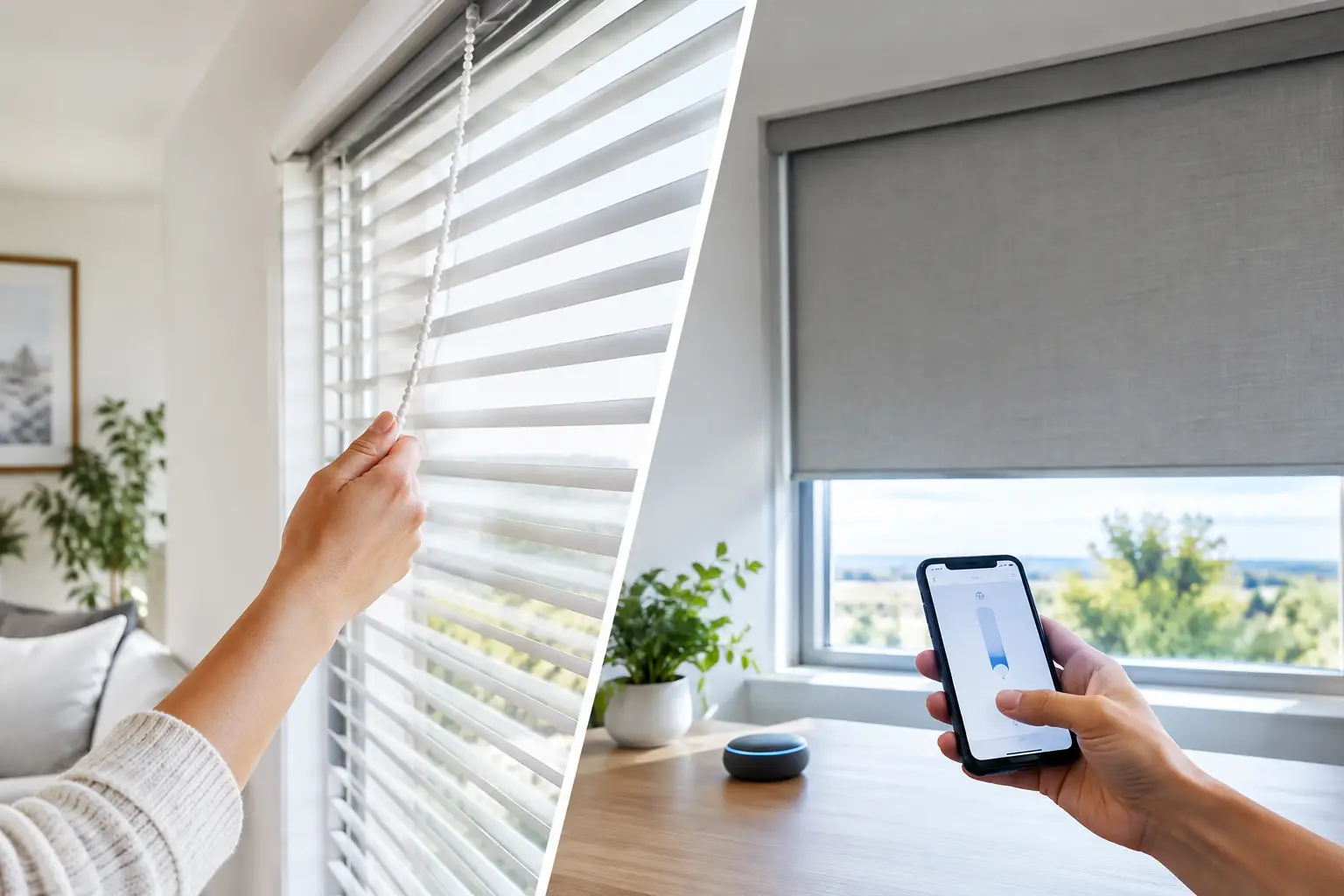
Manual Versus Smart Blinds for Your Home
A west-facing living room can look beautifully bright at 4 p.m. and feel uncomfortably hot by 5. A bedroom may need total darkness in the morning, while a street-facing office needs privacy without losing daylight. The decision between manual versus smart blinds is not only about whether you prefer a cord, wand, or remote. It is about how each window needs to perform, how your household lives, and which details support the look of the room.
Manual systems remain an excellent choice for many custom window coverings. Smart blinds add real value in the right applications, particularly for hard-to-reach windows, full-home projects, and homes that already use automation. The best choice is often not one system throughout the entire house, but a considered combination.
Manual versus smart blinds: the core difference
Manual blinds and shades are operated at the window by hand. Depending on the product, that may mean a cordless lift, a continuous-loop chain, a tilt wand, or a simple hand-operated bottom rail. They are familiar, direct, and available across a wide range of roller shades, Roman shades, honeycomb shades, wood blinds, vertical blinds, woven wood shades, shutters, and drapery.
Smart blinds use a motor to raise, lower, tilt, or traverse the treatment. Control may come from a wall keypad, handheld remote, smartphone app, voice assistant, timer, or an integrated home automation system. Systems from manufacturers such as Lutron, Somfy, Hunter Douglas, Graber, and Alta can be specified with battery power, plug-in power, or hardwired power depending on the window and project requirements.
The difference sounds straightforward, but the buying decision is more nuanced. A manual shade can be the more refined choice for a single decorative Roman shade in a guest room. Motorization may be the more practical choice for a tall bank of roller shades in a great room, even if the fabric and visual style are otherwise identical.
When manual blinds are the better fit
Manual operation is usually the strongest value when windows are easy to reach and the treatment will be adjusted occasionally rather than repeatedly throughout the day. In a dining room, guest bedroom, or secondary office, a cordless cellular shade or a manually operated roller shade offers straightforward light control at a lower initial cost.
There is also a tactile appeal to manual treatments. Tilted wood blinds, tailored woven wood shades, and classic shutters often suit homes where the ritual of opening and closing the window covering is part of the daily routine. With the right lift system, manual does not have to mean dated. Modern cordless options provide a cleaner appearance than older corded designs while helping reduce accessible cord hazards.
Manual blinds can make sense when a project budget is being directed toward premium materials. For example, a homeowner may choose a richly textured woven wood shade, a custom Roman shade with a designer fabric, or high-quality hardwood shutters and keep the operating system manual. That approach prioritizes material, detailing, and visual impact where automation would not substantially improve daily use.
Manual operation does have limits. Large shades can require more effort to raise, and frequently adjusting several windows one by one becomes tedious. It is also less practical for windows above stair landings, behind furniture, over a soaking tub, or high in a vaulted ceiling.
Where smart blinds earn their investment
Smart blinds are most compelling when convenience improves how a room actually functions. Consider a family room with six large windows that receive strong afternoon sun. A single scene can lower solar shades at the right time to manage glare and heat gain, then raise them later to preserve the view. That is a meaningful improvement over remembering to operate every shade individually.
Bedrooms are another strong application. Scheduled blackout shades can lower before bedtime and open gradually in the morning. Pairing motorized blackout roller shades with drapery can create both a polished layered design and effective light control. In condos and urban homes, automated privacy settings can be especially useful for windows facing neighboring buildings.
Smart blinds are also a practical specification for accessibility. A homeowner with limited mobility should not have to stretch, pull, or move furniture to adjust a window covering. For builders and designers, motorization can be a valuable part of an age-in-place plan without compromising the aesthetic direction of the room.
For larger homes, automation adds consistency. Rather than leaving a mix of shades at uneven heights, owners can set whole-room or whole-home scenes. A “movie” setting might lower shades in the media area, while an “away” setting can adjust selected treatments to support privacy and make the home appear occupied. These are useful features, but they should be selected because they solve a real need, not simply because the technology is available.
Battery, plug-in, or hardwired power
Power planning is one of the most important parts of a smart blind specification. Battery-powered motors are often ideal for finished homes and renovations because they avoid opening walls for electrical work. Battery performance varies according to shade size, fabric weight, frequency of use, and motor type, so the charging or battery-replacement plan should be discussed before ordering.
Plug-in systems work well where an outlet can be concealed or integrated neatly, such as behind furniture or within millwork. Hardwired motorization is typically the cleanest choice for new construction or major renovations, especially for multiple windows. It requires early coordination among the window treatment specialist, designer, builder, and electrician. Waiting until trim, drywall, and paint are complete can limit the most elegant installation options.
Design is not secondary to operation
Choosing smart blinds does not mean settling for a technology-first look. Motorization is available in treatments that range from clean-lined roller shades and dual shades to Roman shades, cellular shades, sheer shades, vertical applications, and motorized drapery. The fabric opacity, color, texture, cassette or valance style, and mounting method still determine much of what the eye sees.
The same principle applies to manual treatments. A functional blind should support the architecture and furnishings, not merely cover glass. In a contemporary Toronto condo, a minimal solar roller shade may preserve skyline views while controlling glare. In a traditional home, plantation shutters or layered Roman shades and drapery can add warmth, proportion, and softness. The operating method should follow the design and performance goals of each room.
A useful question is whether the treatment needs to be adjusted daily, seasonally, or only when guests visit. Daily-use windows generally justify spending more time on operation and controls. A treatment that stays in one position most of the time may benefit more from investing in better fabric, insulation, or decorative details.
Cost, maintenance, and long-term expectations
Manual blinds generally cost less because they do not include motors, power components, controls, or programming. They also have fewer electronic elements to maintain. That does not make them maintenance-free: cords, clutches, tilt mechanisms, and brackets can still wear over time, particularly on oversized or heavily used treatments.
Smart blinds carry a higher upfront investment and may require occasional battery charging, app updates, or professional troubleshooting. The quality of the motor, the weight of the treatment, proper installation, and the control ecosystem all matter. A low-cost motorized product is not automatically a better value if it lacks the support, quiet operation, fabric selection, or reliability expected in a custom installation.
It also helps to distinguish between simple motorization and a fully integrated smart-home system. A remote-controlled shade may be all a homeowner needs. Others want scenes coordinated with lighting, climate control, and home security. The latter can be excellent for a full renovation or new build, but it requires more planning and a clearer budget.
A room-by-room approach produces better choices
Instead of asking whether every blind should be manual or smart, assess the windows by use. High, wide, heavy, or difficult-to-reach shades are strong candidates for motorization. So are primary bedroom blackout shades, sun-exposed living areas, patio doors, and rooms where glare affects work or entertainment.
Manual treatments may be the sensible choice for guest rooms, closets, secondary bedrooms, and decorative windows that are rarely adjusted. Many homes use both systems successfully: motorized roller shades in the main living areas, manual Roman shades in quieter rooms, and manual shutters where durable adjustable louvers are the priority.
Before finalizing the selection, consider window dimensions, mounting depth, fabric weight, privacy needs, view preservation, insulation goals, nearby outlets, and who will use the controls. A professional measure is especially valuable for large openings, bay windows, doors, and layered treatments, where small specification decisions affect both appearance and performance.
The right window treatment should feel natural after installation. If a shade is difficult to reach, too heavy to operate comfortably, or never adjusted because it takes too much effort, the lower initial price can lose its appeal. If automation adds control to the rooms you use most, it can become one of the most appreciated details in the home. A consultation with Window Fashions Depot can help match the operating system, material, and custom fit to the way each window is meant to live.
0 comments